

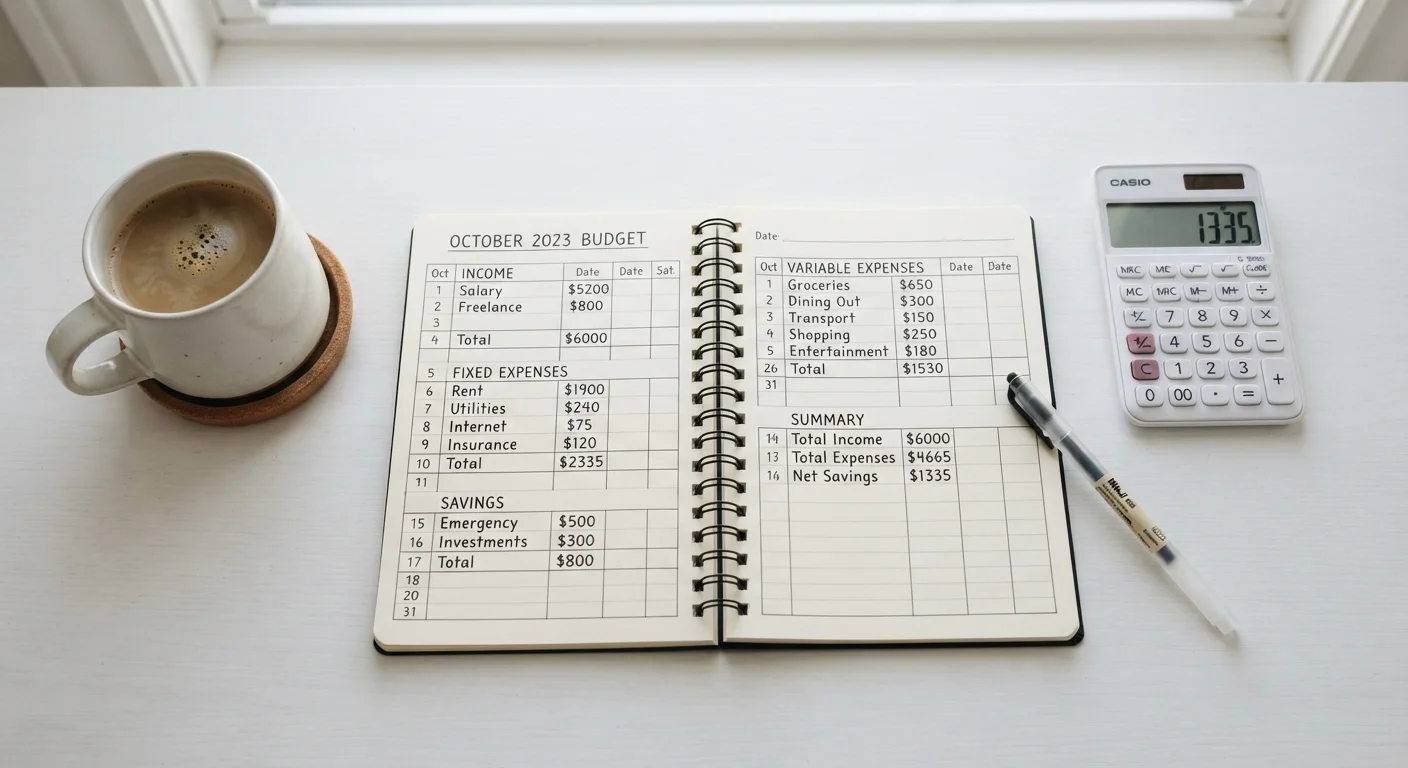
Why Budgeting Works
A personal budget is simply a written plan for how you intend to use your money each month. It does not require complex software or financial expertise — it requires honesty about income, awareness of spending, and a few minutes of attention each week.
Research in behavioral economics consistently shows that people who track and plan their spending accumulate more savings and carry less high-interest debt than those who do not. The mechanism is straightforward: when you know exactly where your money goes, you make more deliberate choices about where it goes next.
If you have never set up a formal budget before, our step-by-step guide for first-time budgeters covers the foundational setup in plain English.
74%
Americans living paycheck to paycheck
According to a 2023 LendingClub report, nearly three in four U.S. consumers reported spending all or most of their income each month.
32%
Adults with a detailed written budget
Gallup polling has consistently found that fewer than one in three U.S. adults maintains a detailed household budget.
3–6 months
Recommended emergency fund coverage
Most mainstream financial guidance, including from the Consumer Financial Protection Bureau, targets three to six months of essential expenses.
Choosing a Budgeting Method
No single method fits every household. The frameworks below are among the most widely used in personal finance. Each has genuine strengths depending on your income structure, financial goals, and personal temperament.
The 50/30/20 Rule
Allocate roughly 50% of after-tax income to needs (housing, food, utilities, transportation), 30% to wants (dining out, subscriptions, entertainment), and 20% to savings and debt repayment. This rule works well as a starting framework but may need adjustment if you live in a high cost-of-living area or carry significant debt.
Zero-Based Budgeting
Assign every dollar of income a specific job — expenses, savings, or debt payment — so that income minus allocations equals zero. Nothing sits unplanned. This approach requires more upfront work but leaves no room for vague, untracked spending.
Envelope Budgeting
Divide cash (or digital equivalents) into spending categories at the start of the month. When a category envelope is empty, spending in that category stops. This method is particularly effective for people who struggle with overspending in specific areas like groceries or dining.
Run your budget on net (after-tax) income, not gross. Gross income creates an inflated sense of available funds that leads to systematic overspending.
Tax withholdings, Social Security, and Medicare contributions are non-negotiable deductions — budgeting from take-home pay reflects what you actually control.
Build a 'miscellaneous' category of roughly 3–5% of your monthly budget for genuinely unexpected costs. This preserves the rest of your plan when small surprises arise.
Most budget failures stem not from large predictable expenses but from the accumulation of small unplanned costs that crowd out savings allocations.
Whatever method you choose, be aware of the expenses most budgets overlook — annual fees, irregular bills, and subscriptions that derail even well-designed plans.
Tracking Your Spending
Choosing a method means nothing if spending goes untracked. Tracking closes the gap between your intended budget and your actual behavior.
Common tracking approaches include:
- Spreadsheets: Flexible and free. Google Sheets or Excel templates let you customize categories and see your full picture in one place.
- Budgeting apps: Many connect directly to bank and credit card accounts, automatically categorizing transactions. Review automated categories regularly — misclassification is common.
- Pen and paper: Low-tech but effective for those who find digital tools distracting or who prefer physical records.
The tracking method matters far less than frequency. Checking your spending at least once per week prevents small overages from compounding into large ones by month's end. For a structured approach to monthly reviews, see our guide on conducting a monthly money check-in.
Review More Than Once a Month
Most people check their budget only when paying bills — by then, overspending has already happened. A brief five-minute weekly scan of spending-to-date against your budget catches problems while you still have time to correct them that month.
Handling Irregular Income
Freelancers, gig workers, commission-based employees, and small business owners face a distinct challenge: income that varies month to month makes fixed budgeting feel impossible. It is not — it simply requires a different anchor.
A practical approach is to identify your baseline income — the lowest amount you reliably earn in an average month — and build your core budget around that figure. Any income above the baseline goes into a designated buffer account first, then gets allocated to savings goals or debt repayment once the core budget is funded.
This model prevents lifestyle inflation during high-earning months and protects essential expenses during slow ones. It also pairs naturally with building a robust emergency fund, which financial professionals commonly recommend should cover three to six months of essential expenses.
Don't Budget on a Best-Case Income
Planning your monthly expenses around your highest recent paycheck is one of the most common mistakes variable-income earners make. If income drops — as it regularly does in gig and freelance work — fixed obligations like rent and car payments will not flex with it. Always anchor your non-negotiable expenses to a conservative income estimate.
Building Savings Goals Into Your Budget
Savings should appear in your budget as a line item with the same priority as rent or utilities — not as whatever is left over after spending. This is often described as paying yourself first, and it is one of the most consistent findings in personal finance practice.
Define each savings goal with a specific dollar amount and target date. Then divide the total by the number of months remaining to establish a monthly contribution. Whether the goal is an emergency fund, a vacation, a home down payment, or retirement contributions, this approach makes the abstract concrete and actionable.
Explore saving and goal-setting strategies for deeper guidance on structuring short- and long-term financial targets.
“A budget is telling your money where to go instead of wondering where it went.”
— Dave Ramsey, Personal finance author and radio host
Adjusting Your Budget as Life Changes
A budget written in January may be almost unrecognizable by October — and that is normal. Life events such as a job change, a new dependent, a move, or a major health expense all require budget revisions.
Rather than abandoning your budget when circumstances shift, treat it as a living document. Schedule a formal review at least once per quarter, and do an immediate review after any significant financial event. Update income figures, add or remove categories, and re-align savings targets to your current reality.
If debt has accumulated or is actively complicating your budget, understanding how interest rates and credit utilization affect your financial picture is essential — our credit and debt guidance hub provides clear, practical context for managing those obligations alongside your monthly plan.
This article is for general informational and educational purposes only and does not constitute personalized financial advice. Please consult a licensed financial professional for guidance specific to your individual circumstances.