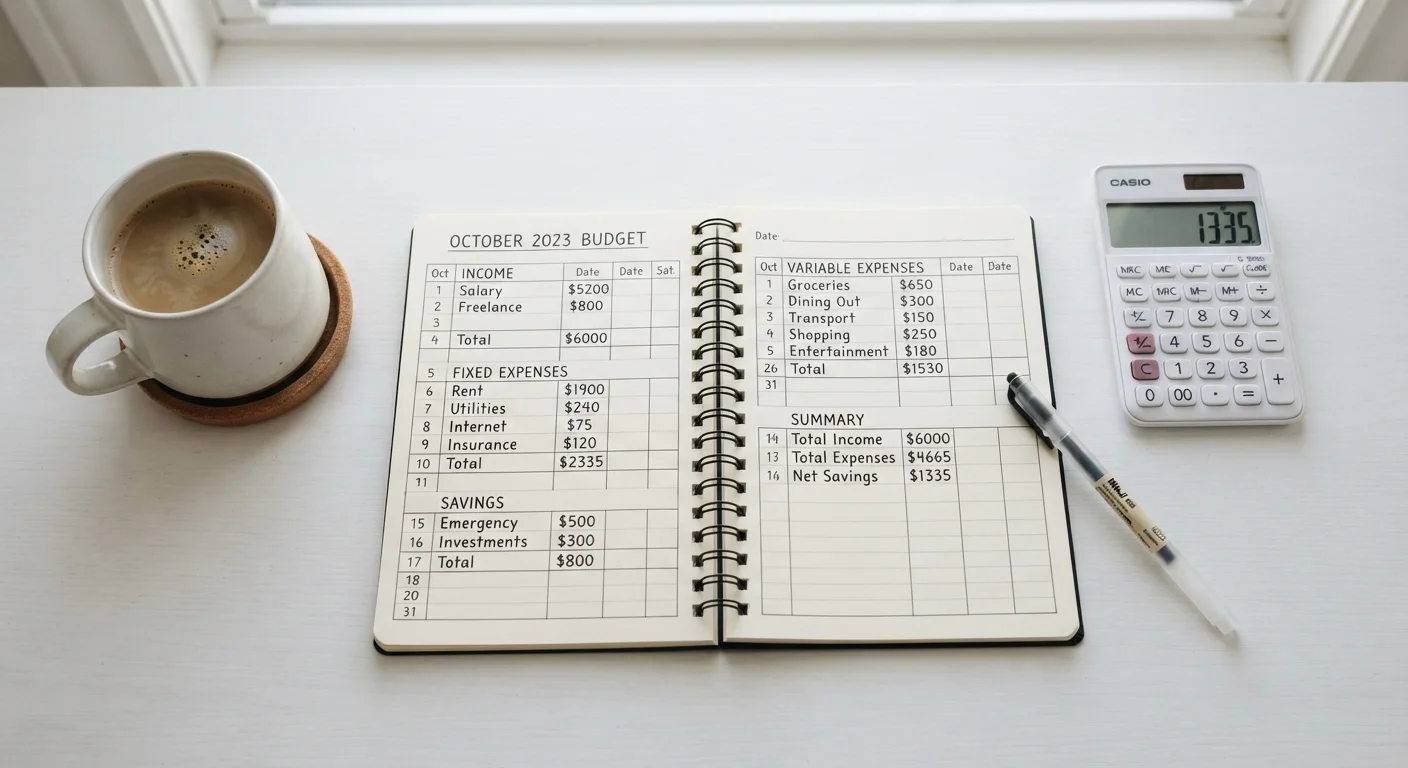


Why a Monthly Budget Matters
A budget is not a restriction on your life — it is a map of where your money goes. Without one, spending tends to expand quietly into whatever income is available, leaving many people uncertain about why their account balance is lower than expected. A monthly budget creates visibility: you see the numbers, and you can make deliberate choices rather than reactive ones.
The monthly cycle is the most practical unit for budgeting because most fixed expenses — rent, loan payments, subscriptions — recur monthly, and most Americans are paid weekly, bi-weekly, or monthly. Aligning your plan to the calendar month makes it straightforward to compare what you earned against what you spent. For a deeper look at the full landscape of budgeting methods and tools, see our complete personal budgeting guide.
Step 1: Calculate Your Real Take-Home Income
Your budget must be built on net income — the money that actually lands in your bank account after federal and state taxes, Social Security, Medicare, and any pre-tax deductions like a 401(k) contribution or health insurance premium. Using your gross salary overstates what you have available and will cause your budget to fall short every month.
If you receive a regular paycheck, check your pay stub for the net amount. If you are paid bi-weekly, multiply that figure by 26 and divide by 12 to find your average monthly net. If your income varies, use a conservative estimate — ideally the average of your three lowest recent months. For more strategies tailored to variable pay, see our guide on budgeting on an irregular income.
Net income
The amount of money you actually receive after all taxes and pre-tax deductions have been taken out of your paycheck. This is the figure you should use when building a budget.
Fixed expense
A recurring cost that stays the same amount every month, such as rent, a car payment, or a fixed-rate loan payment.
Variable expense
A recurring cost whose amount changes month to month, such as groceries, gas, or utility bills.
Irregular expense
A cost that doesn't occur every month but is predictable over the year, such as an annual insurance premium, car registration, or holiday spending.
50/30/20 rule
A simple budgeting guideline that divides after-tax income into three categories: 50% for needs, 30% for wants, and 20% for savings and debt repayment.
Zero-based budget
A budgeting method where every dollar of income is assigned a specific purpose, so that income minus all allocations equals zero at the end of the month.
Step 2: List and Categorize Your Expenses
Pull up two to three months of bank and credit card statements and write down every expense you see. Then sort each item into one of three buckets:
- Fixed expenses: Same amount, same date every month — rent or mortgage, car payment, insurance premiums, loan minimums.
- Variable expenses: Recurring but fluctuating — groceries, gas, utilities, dining out, entertainment.
- Irregular expenses: Infrequent but predictable — annual subscriptions, car registration, holiday gifts, medical co-pays.
Many first-time budgeters skip the third category entirely, then wonder why their budget breaks in March or December. Divide your known annual irregular costs by 12 and set that amount aside each month. Our article on spending categories most budgets forget walks through the most commonly overlooked items.
Use Bank Statements, Not Memory
When listing your expenses, rely on actual transaction records rather than estimates from memory. Most people underestimate their spending by 20–30% when guessing. Two to three months of statements give you a reliable picture of real patterns — not an idealized version of them.
Step 3: Choose a Budgeting Framework
Once you know your income and expenses, you need a framework to organize the relationship between them. Three approaches suit beginners well:
- 50/30/20 Rule: Allocate roughly 50% of net income to needs, 30% to wants, and 20% to savings and debt repayment above minimums. It is flexible and requires minimal tracking.
- Zero-Based Budget: Assign every dollar a job so that income minus all allocations equals zero. More precise, but takes more time each month.
- Pay-Yourself-First: Automatically transfer a set savings amount as soon as income arrives, then budget the remainder. Learn more in what paying yourself first actually means.
No framework is inherently superior — the one you will actually use consistently is the right one. If you want an honest look at rigidity versus flexibility, the case for and against a strict budget offers a balanced perspective.
Step 4: Set Spending Limits and Track Results
With a framework chosen, assign a dollar limit to each expense category based on your actual historical spending and your income constraints. Start with fixed expenses first — they are non-negotiable anchors. Then allocate to variable categories based on what is realistic, not aspirational. If you are left with nothing for savings after covering essentials, that gap is the signal: something variable needs to come down.
Track spending throughout the month by recording transactions as they happen or reviewing your accounts every few days. At month's end, compare actuals to your plan. The goal is not perfection — it is pattern recognition. Over two or three months, you will identify where your real pressure points are. Use our monthly budget setup checklist to ensure you haven't missed any setup steps. To explore tracking tool options before committing, see spreadsheet vs. budgeting app.
Don't Set Limits You Can't Realistically Meet
A common first-budget trap is setting spending targets that look good on paper but bear no relationship to your actual habits. An unrealistically tight grocery or gas limit will cause the budget to fail within the first week, leading many people to abandon it entirely. Start with honest baselines and tighten gradually over several months.
Common First-Budget Mistakes to Avoid
Most early budget failures come from predictable errors rather than lack of discipline. Watch for these:
- Building an ideal budget, not a real one. Set limits based on what you actually spend, then adjust downward gradually — not all at once.
- Forgetting irregular expenses. These will hit eventually; plan for them monthly so they don't feel like surprises.
- Abandoning the budget after one bad month. One overspent month is data, not failure. Adjust and continue.
- Neglecting savings as a line item. If savings are not explicitly in the budget, they tend not to happen. Treat saving like any other expense. See the pay-yourself-first method for one approach.
Once your monthly budget feels stable, the logical next step is building a savings plan that works alongside it. Building a savings plan around real life offers a practical framework for doing exactly that. For broader guidance on savings and financial goals, explore the Saving & Goals hub.
This article is for general informational and educational purposes only. It does not constitute personalized financial, tax, or legal advice. Consult a qualified financial professional for guidance specific to your situation.