

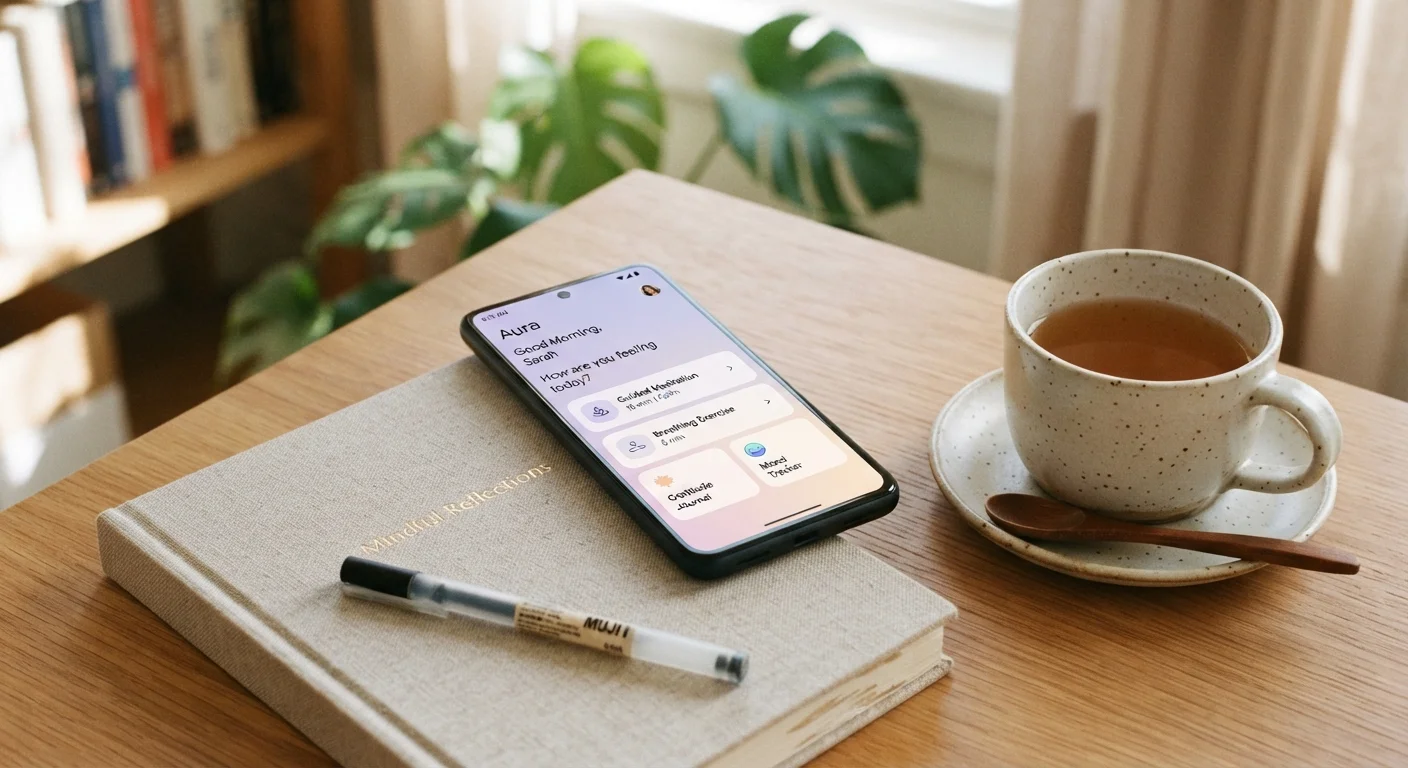
What Mental Health Apps Actually Offer
The mental health app market has expanded dramatically, with thousands of platforms offering guided meditation, mood tracking, cognitive behavioral therapy (CBT) exercises, sleep support, and crisis resources. For many users, these tools represent a first point of contact with mental health support — especially for those who face barriers to in-person care such as cost, geography, or stigma.
If you're new to thinking intentionally about your mental health, see our practical starting point for beginners before evaluating whether an app belongs in your routine. Understanding what these platforms can and cannot do is essential for using them well.
Available anytime, anywhere — no appointment needed
Apps eliminate common access barriers like scheduling, transportation, and long waitlists, making support available during the moments users actually need it.
Lower cost than traditional therapy
Many apps offer free tiers or low monthly subscriptions, making mental health support more financially accessible for individuals without insurance coverage or limited income.
Useful for building daily coping habits
Structured daily check-ins, breathing exercises, and guided journaling can reinforce healthy routines over time, particularly for mild stress and mood management.
Reduces stigma as a first step
For people hesitant to seek in-person help, an app can serve as a low-stakes starting point that normalizes engaging with mental health tools.
Mood tracking provides useful self-awareness
Longitudinal mood logs can help users identify patterns, triggers, and progress — data that can also be valuable to share with a therapist or physician.
The Real Drawbacks Worth Knowing
Despite the appeal, mental health apps carry limitations that are frequently underemphasized in marketing and media coverage. The most critical concern is the gap between clinical effectiveness and commercial availability — apps can launch and scale rapidly without the rigorous trials required of medical treatments.
Limited clinical evidence for most platforms
The majority of commercially available mental health apps have not been tested in rigorous, independent randomized controlled trials. Effectiveness claims are often extrapolated from weaker study designs.
Not suitable for moderate-to-severe conditions
Apps are not equipped to assess, diagnose, or treat clinical depression, PTSD, bipolar disorder, or other serious conditions. Relying on them in place of professional care can delay necessary treatment.
Significant data privacy concerns
Mental health data is among the most sensitive personal information. Many apps share data with third parties, and privacy policies can be difficult to parse or are subject to change.
High dropout rates limit long-term benefit
Studies consistently show that user engagement with mental health apps drops sharply within the first month. Without sustained use, potential benefits are unlikely to accumulate.
Risk of replacing rather than complementing care
Users experiencing genuine distress may feel the app is "enough," potentially deferring evaluation or treatment from a licensed mental health professional.
Apps and Social Isolation: A Nuance to Consider
For people already experiencing loneliness, an app-centered mental health routine may inadvertently reduce motivation to seek human connection. Research is clear that social connection is a fundamental driver of emotional health. If isolation is a factor in your wellbeing, our article on social connection and mental health explains what the evidence says about loneliness and the brain — and what actually helps.
For a broader look at where self-directed tools fit alongside professional support, our article on therapy vs. self-help offers a clear-eyed comparison of what each approach can realistically deliver.
How the Evidence Actually Stacks Up
Research on mental health apps is still catching up to the market. Some apps, particularly those grounded in CBT or mindfulness-based stress reduction (MBSR), have shown promise in small to mid-sized clinical trials for reducing mild anxiety and depressive symptoms. However, study quality varies significantly, follow-up periods are often short, and many trials are funded by the app developers themselves — a conflict of interest worth noting.
10,000+
Mental health apps available in major app stores
Estimates from mental health research organizations suggest the market has grown to over 10,000 apps, the vast majority without peer-reviewed validation.
~4%
Apps with published clinical trial evidence
A review published in npj Digital Medicine found that only a small fraction of available mental health apps have supporting evidence from controlled trials.
Less than 4 weeks
Median active use period for mental health apps
Research on app engagement consistently shows most users stop regular use within the first month after downloading.
Apps designed around evidence-based techniques — like structured breathing, behavioral activation, or sleep hygiene education — tend to perform better than loosely designed "wellness" platforms. Our article on daily mental wellness habits covers the specific practices with the strongest research support, many of which can be reinforced through apps when implemented thoughtfully.
Mindfulness features are common across most apps, but the terms are often used loosely. Understanding the distinction matters — see our piece on mindfulness vs. meditation for clarity on what each practice involves and when it's most useful.
This article is for general informational purposes only and does not constitute medical or mental health advice. If you are experiencing mental health symptoms, please consult a qualified healthcare professional.