

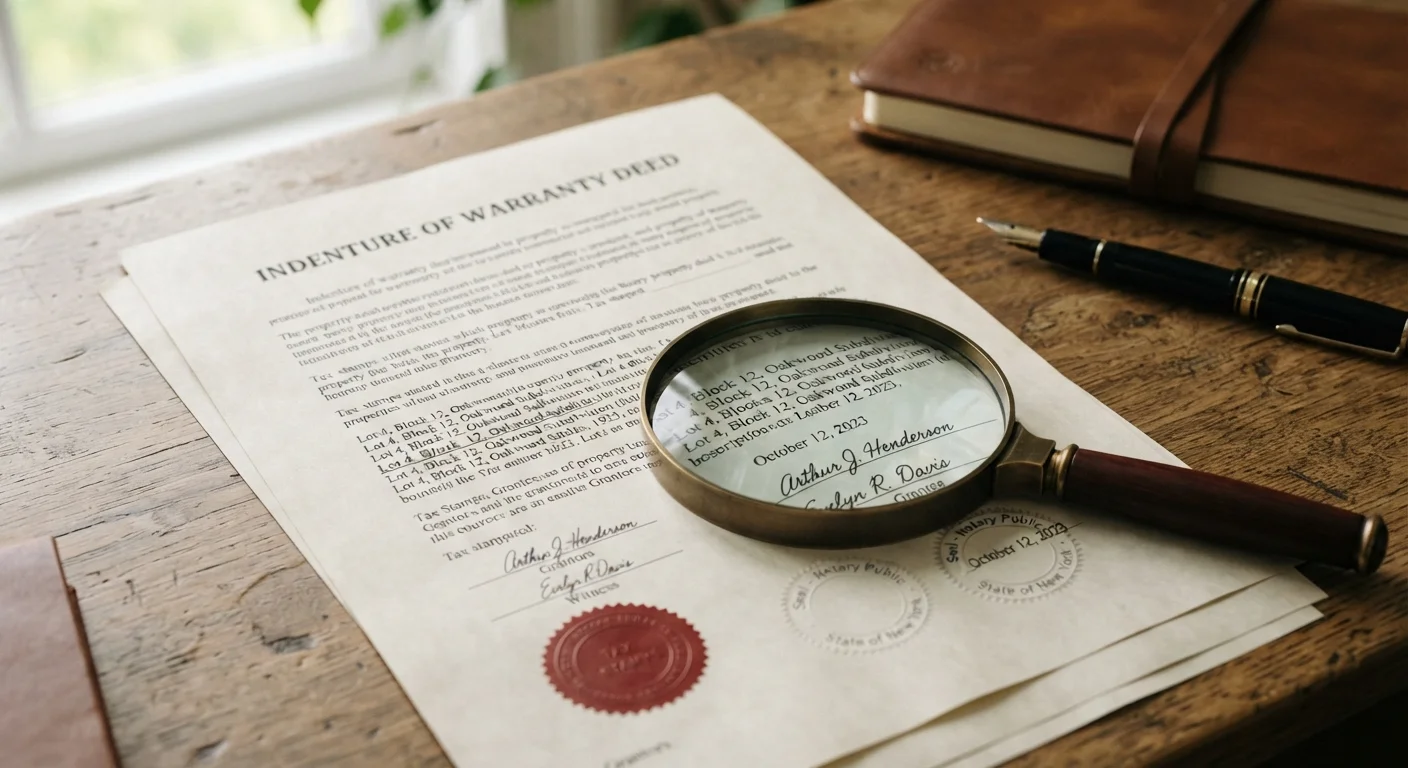
What Title Insurance Actually Covers
Title insurance addresses a specific category of risk: defects in a property's chain of ownership that predate your purchase. When you buy a home, a title company conducts a title search — reviewing public records to trace ownership history and flag potential problems. But not every defect is discoverable through a search. Title insurance fills that gap.
Common covered risks include:
- Forged or fraudulent documents — A prior deed or transfer signed by someone impersonating the owner
- Undisclosed heirs — A previous owner's relative who surfaces with a valid ownership claim
- Unpaid liens — Outstanding contractor bills, tax debts, or judgments attached to the property before closing
- Clerical errors — Mistakes in public records, such as incorrect property descriptions
- Boundary disputes — Encroachments or easements that were not properly recorded
If a covered defect surfaces after closing, the insurer typically defends the claim in court and compensates covered losses up to the policy limit — all at no additional cost to the policyholder.
Title Insurance vs. Title Search: Not the Same Thing
A title search is a review of public records to identify known defects. Title insurance is a separate product that covers losses from defects the search missed or that were not discoverable. Both typically occur as part of the closing process, but purchasing one does not substitute for the other.
What Title Insurance Does Not Cover
Understanding exclusions is just as important as understanding coverage. Title insurance does not protect against every property-related risk. Common exclusions include:
- Zoning restrictions or code violations unrelated to ownership history
- Physical condition issues — structural defects, environmental hazards, or pest damage
- Problems created by the buyer after closing, such as a new lien from unpaid contractors
- Government takings (eminent domain) that occur after closing
- Issues a buyer was explicitly informed of before closing
Because title insurance covers ownership history rather than property condition, buyers should arrange a separate home inspection and consider other protections — such as homeowner's insurance — to cover physical risks. For other types of specialized insurance that work differently from conventional policies, see our explainer on how pet insurance works.
Why Lenders Require Title Insurance
When a mortgage lender funds a home purchase, their loan is secured by the property itself. If a title defect later voids or diminishes the borrower's ownership rights, the lender's collateral is at risk. A lender's title policy protects the financial institution's interest — typically equal to the loan amount — for the life of the loan.
This requirement is standard across virtually all conventional, FHA, and VA loans. Without a clear, insured title, lenders face the possibility of financing a property over which the borrower does not have legally defensible ownership.
~$2B
Annual title insurance claims paid in the U.S.
The American Land Title Association has reported that title insurers pay out billions annually in claims and related expenses, underscoring that title defects are not hypothetical.
1 in 3
Title searches that uncover a defect requiring correction
Industry estimates from ALTA suggest that roughly one-third of all title searches find some issue that must be resolved before a transaction can close safely.
It is worth noting that a lender's policy only protects the lender, not the buyer. If a title claim arises and the buyer has no owner's policy, the lender's insurer may clear the lender's interest while leaving the homeowner exposed to personal financial loss or even eviction.
Owner's Policy vs. Lender's Policy: A Critical Distinction
These two policy types are frequently confused, yet they serve entirely different parties.
| Policy Type | Who It Protects | Coverage Amount | Duration |
|---|---|---|---|
| Lender's Policy | The mortgage lender | Up to the loan balance | Until the loan is paid off |
| Owner's Policy | The property buyer | Up to the purchase price | As long as owner holds title |
The owner's policy is often offered simultaneously at a discounted simultaneous-issue rate when purchased alongside the lender's policy at closing. Once the loan is paid off, the lender's policy expires — but an owner's policy remains in force for as long as the insured or their heirs retain an interest in the property.
Understanding the roles of different professionals in a real estate transaction can help clarify who oversees title work. A real estate attorney often conducts or reviews the title search in attorney-closing states, while a real estate agent coordinates the transaction but generally does not provide legal title opinions.
This article is for general informational purposes only and does not constitute legal, financial, or insurance advice. Consult a licensed real estate attorney or insurance professional for guidance specific to your situation.