

What Determines How Long a Battery Lasts
A conventional 12-volt lead-acid battery — the type found in the vast majority of passenger vehicles — doesn't age at a fixed rate. Its longevity is shaped by a combination of environmental conditions, usage patterns, and electrical demand.
Heat is the single biggest enemy. High under-hood temperatures accelerate the chemical reactions inside a battery, causing internal plates to corrode and electrolyte fluid to evaporate faster. Drivers in consistently hot climates often see batteries fail in as little as two to three years. Cold weather, by contrast, reduces the battery's ability to deliver cranking power but doesn't degrade it as quickly as sustained heat does.
Driving habits matter significantly. Every engine start draws a heavy current from the battery, and the alternator is responsible for replenishing that charge during driving. Short urban trips — common in stop-and-go commuting — don't give the alternator enough running time to fully recharge the battery. Over months and years, this pattern of shallow cycling weakens the battery's capacity.
Electrical load plays a growing role in modern vehicles packed with infotainment systems, heated seats, backup cameras, and driver-assistance technology. Parasitic drain — electricity drawn from the battery when the vehicle is off — can also shorten battery life, especially if a vehicle sits unused for extended periods. Owners of stored or rarely driven vehicles should pay particular attention to this; see our guide on protecting a stored vehicle's battery and systems for relevant precautions.
Recognizing the Warning Signs
Batteries rarely fail without giving some advance notice. Recognizing the early signals can mean the difference between a planned replacement and an unexpected breakdown.
3–5 years
Typical car battery lifespan
Industry guidance consistently places conventional lead-acid battery life in this range under normal driving conditions.
~2–3 years
Battery life in extreme heat climates
Batteries in hot-weather regions often degrade significantly faster due to accelerated internal corrosion and fluid loss.
12.6 V
Resting voltage of a fully charged battery
A reading noticeably below this at rest — particularly under 12.2 V — suggests partial discharge or degraded capacity.
- Slow or labored cranking: If the engine turns over more slowly than usual when starting — especially on a warm morning — the battery may not be delivering full current. This is one of the earliest and most reliable indicators.
- Dim or flickering lights: Headlights that appear noticeably dimmer at idle, or interior lights that flicker when electrical accessories are in use, suggest the battery isn't holding adequate charge.
- Frequent jump-starts needed: Needing a jump-start more than once in a short period is a clear signal the battery is no longer reliably self-sustaining.
- Battery warning light: Modern vehicles monitor charging system voltage. A persistent battery or charging system warning on the dashboard warrants immediate professional diagnosis.
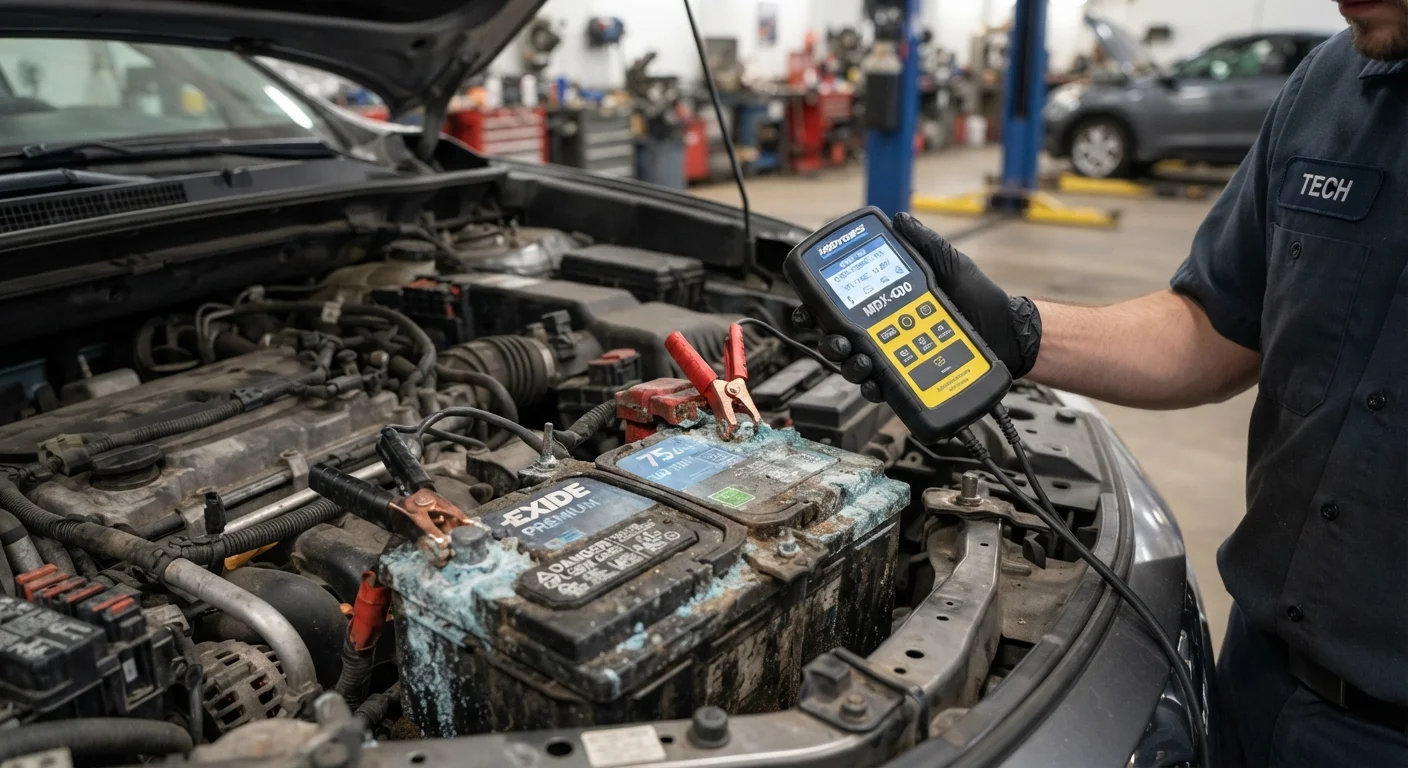
- Swollen or leaking case: A battery case that appears bloated or shows signs of corrosion buildup around the terminals indicates internal damage, often from overcharging or excessive heat exposure.
- Age alone: Any battery approaching or past the four-year mark deserves a proactive load test, even if no symptoms are present.
Test Before Winter, Not After
Cold weather exposes battery weakness but rarely causes it. Having your battery load-tested in early fall — before temperatures drop — gives you time to replace it on your own schedule rather than in an emergency. Most auto parts stores offer this service at no charge.
Testing and What to Do Next
A simple voltage check with a multimeter can give a rough sense of battery state — a fully charged battery should read around 12.6 volts at rest. However, a voltage reading alone doesn't reveal how the battery performs under the real-world stress of starting an engine.
A load test, performed with professional equipment at most auto parts stores or repair shops, applies a controlled electrical load and measures how well the battery maintains voltage. This is the most accurate way to assess remaining capacity and catch a battery that's close to failure. Technicians can also test the alternator simultaneously, since a failing alternator can disguise itself as a battery problem.
Battery vs. Alternator: Know the Difference
If a battery dies again shortly after being jump-started, the alternator — not the battery — is often the root cause. The alternator charges the battery while the engine runs; a failing alternator can't sustain the charge. Both components should be tested together when diagnosing starting or charging problems.
If a battery is confirmed to be failing, replacement is straightforward for most vehicles. The new battery should match or exceed the original's cold cranking amp (CCA) rating specified by the manufacturer. On some late-model vehicles with sophisticated battery management systems, the replacement battery may need to be registered to the vehicle's computer — a step a qualified technician should handle to avoid charging system issues.
Understanding what degrades a battery over time isn't unlike understanding other wear-and-fade patterns across everyday products — though, as with garments versus batteries, the mechanisms differ considerably. What remains consistent is that proactive attention beats reactive replacement.