

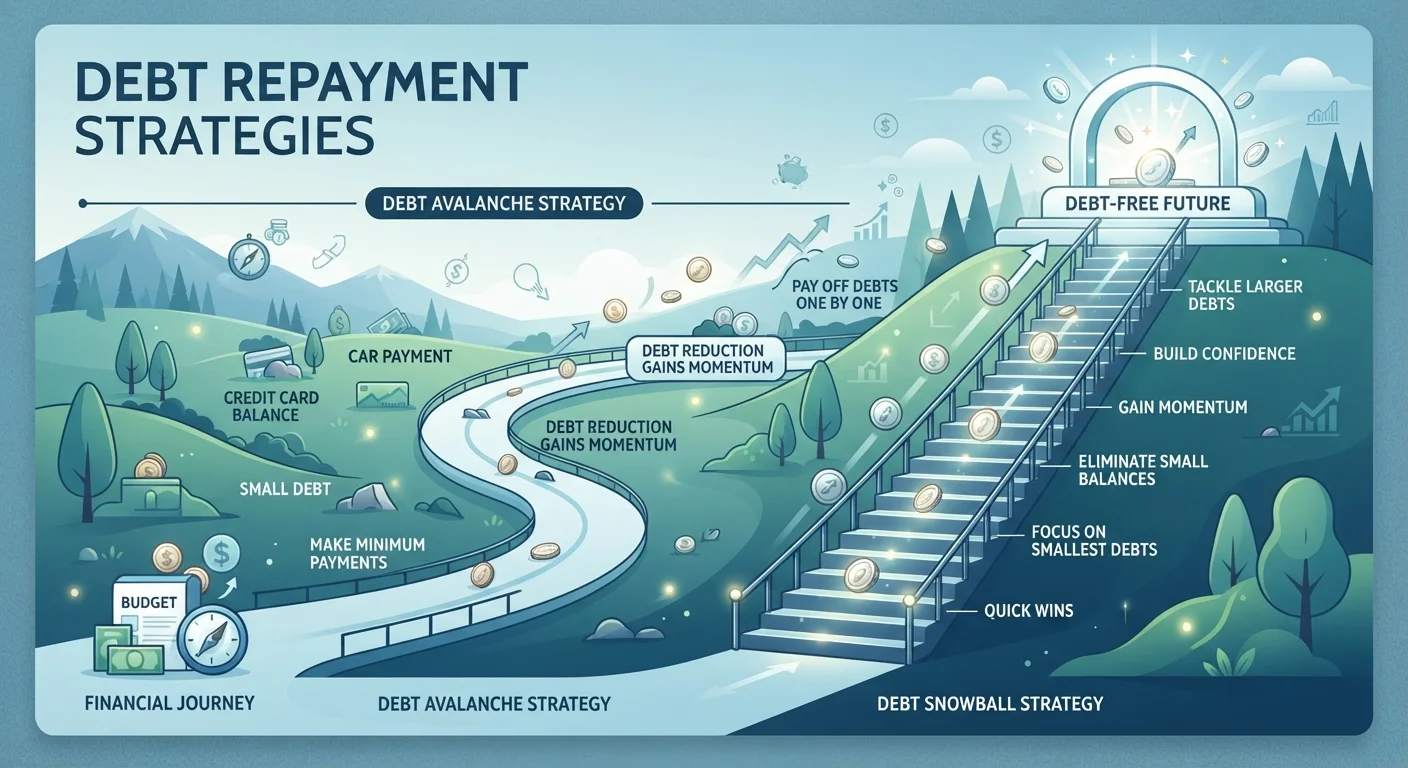
How Each Strategy Works
Both the debt avalanche and the debt snowball follow the same foundational rule: make minimum payments on every debt each month, then direct any remaining available funds toward one designated priority account. The two methods differ only in how they define that priority.
Debt Avalanche: You rank your debts by interest rate, from highest to lowest, and focus extra payments on the highest-rate balance first. Once that balance reaches zero, you roll its payment amount into the next-highest-rate debt, and so on — like an avalanche gaining force as it moves.
Debt Snowball: You rank your debts by outstanding balance, from smallest to largest, and attack the smallest balance first. Each eliminated account frees up its minimum payment, which you stack onto the next smallest debt — growing your payment capacity like a rolling snowball.
Neither method requires additional income, though having extra funds to direct accelerates both. You can also combine these approaches with debt consolidation strategies if restructuring your obligations makes sense for your situation.
| Criterion | Debt Avalanche | Debt Snowball |
|---|---|---|
| Payoff order | Highest interest rate first | Smallest balance first |
| Total interest paid | Lower (mathematically optimal) | Potentially higher |
| Time to first payoff | Longer (if high-rate debt is large) | Shorter (quick early wins) |
| Motivational approach | Discipline and long-term focus | Momentum from quick wins |
| Best debt profile | Few debts with wide rate spread | Many accounts of varying sizes |
| Complexity | Requires tracking interest rates | Straightforward to organize |
The Real Difference: Math vs. Motivation
The core trade-off between these two strategies is the tension between financial efficiency and behavioral sustainability.
From a purely mathematical standpoint, the debt avalanche wins. By eliminating high-interest balances first, you prevent the most expensive interest from compounding for as long, which typically results in lower total interest paid and a faster overall payoff — assuming consistent execution.
However, financial behavior research consistently shows that many people don't make decisions purely on math. A study published in the Journal of Marketing Research found that consumers who focused on eliminating smaller debts first were more likely to eliminate their entire debt portfolio, suggesting that the psychological benefit of visible progress is a real and meaningful variable — not just a soft consideration.
This is why financial educators often frame the choice not as which method is smarter, but which method you'll actually finish. An avalanche strategy abandoned halfway through costs far more than a snowball strategy completed in full.
~$1,000+
Potential interest savings with the avalanche method
The actual savings vary widely by balance size, rates, and payoff speed, but can be substantial on high-rate credit card debt over several years.
77%
Americans carrying some form of debt
According to Experian's consumer credit data, the vast majority of U.S. adults carry at least one form of active debt obligation.
20%+
Average credit card APR in recent years
The Federal Reserve tracks average credit card interest rates, which have risen significantly in recent high-rate environments, making payoff strategy choice more impactful.
Before committing to either approach, it's worth evaluating your broader financial picture. The pay-yourself-first method can complement either strategy by automating a savings contribution before any discretionary spending is available — reducing the temptation to redirect extra funds away from your debt plan.
Choosing the Right Method for Your Situation
There is no universally correct answer here. The right method depends on your debt profile, your temperament, and your track record with financial commitments.
Consider the avalanche if: your highest-interest debts carry significantly higher rates than others (say, 24% APR credit card debt versus a 6% personal loan), you have a history of following through on long-term financial plans, and minimizing the total cost of debt is your primary objective.
Consider the snowball if: you have multiple small accounts that feel overwhelming to manage, you've previously abandoned debt payoff plans, or you respond well to short-term milestones. Seeing account balances hit zero can be a powerful reinforcement mechanism.
It's also worth noting that habits that prevent debt from growing matter as much as the payoff method itself. If new charges continue to accumulate on paid-down accounts, neither strategy will achieve its intended effect.
For those managing severe or long-delinquent debt, understanding how debt progresses — and what recovery realistically involves — is an important first step. The path through charge-offs and collections works differently than active debt management, and may require different tools altogether.
This article is for general informational and educational purposes only and does not constitute personalized financial or legal advice. Readers should consult a qualified financial professional before making decisions about debt repayment specific to their circumstances.