

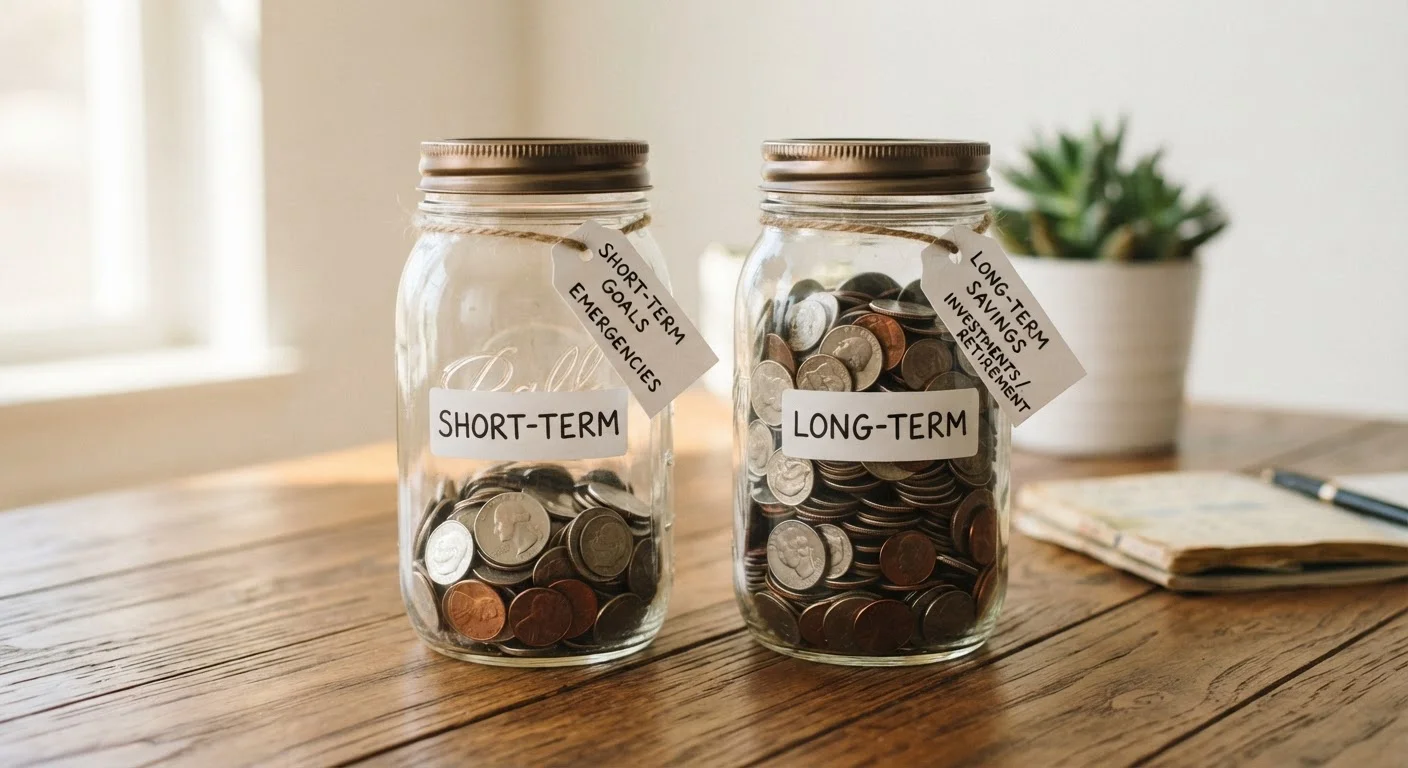
Why the Timeline Changes Everything
The most common savings mistake isn't saving too little — it's treating all savings the same regardless of when you need the money. Short-term and long-term goals require fundamentally different strategies because they answer different questions: How soon will I need this? and How much can I afford to lose along the way?
A short-term goal — think an emergency fund, a vacation, or a car repair fund — has a horizon of roughly one to three years. The priority is liquidity (easy access) and capital preservation (keeping what you put in). A long-term goal, such as retirement or a child's education fund, won't be touched for five, ten, or twenty-plus years. That runway allows your money to absorb market volatility and benefit from compound growth over time.
Confusing the two leads to predictable problems: pulling money out of a long-term investment account early and paying penalties, or parking retirement savings in a low-yield account and missing decades of compounding. Understanding goal-based saving — earmarking funds for specific purposes — is the first step toward getting this right.
| Criterion | Short-Term Goals | Long-Term Goals |
|---|---|---|
| Typical timeline | Under 3 years | 5+ years |
| Primary priority | Liquidity & preservation | Growth & compounding |
| Suitable accounts | HYSA, money market, CD | 401(k), IRA, 529, brokerage |
| Market exposure | Minimal or none | Higher; volatility is manageable |
| Penalty for early withdrawal | Usually none (except CDs) | Often significant (retirement accounts) |
| Tax advantages | Generally none | Often significant (401k, IRA, 529) |
| Key risk | Inflation eroding purchasing power | Market volatility (short term) |
Choosing the Right Account for Each Goal
Account selection is where strategy becomes concrete. For short-term goals, the two most practical options are high-yield savings accounts (HYSAs) and certificates of deposit (CDs). HYSAs offer FDIC-insured liquidity with interest rates meaningfully above traditional savings accounts. CDs lock your money for a fixed term but typically offer a slightly higher yield in exchange — useful when you know exactly when you'll need the funds. For a deeper look at how these compare, see our article on high-yield savings accounts vs. regular savings accounts.
For long-term goals, the account options widen considerably. Tax-advantaged retirement accounts such as 401(k)s and IRAs are designed for multi-decade timelines. For education goals, 529 plans offer tax-free growth when funds are used for qualified education expenses. For general long-term goals outside these categories, a brokerage account provides investment flexibility, though it lacks dedicated tax advantages.
56%
Americans who couldn't cover a $1,000 emergency from savings
According to a Bankrate survey, more than half of U.S. adults could not pay an unexpected $1,000 expense from their savings without borrowing or using credit.
10x
Approximate long-run growth from compounding over 30 years
At a hypothetical 8% average annual return, a dollar invested today could grow roughly tenfold over 30 years, illustrating why timeline dramatically affects long-term goal strategy.
~0.45%
Average APY on traditional savings accounts (FDIC data)
The FDIC periodically publishes national average deposit rates; traditional savings accounts have historically offered modest yields compared to high-yield alternatives.
The key distinction: short-term accounts should almost never hold market-linked investments. If a stock market dip coincides with the month you need to pay for a home repair, you could be forced to sell at a loss. Long-term accounts, by contrast, can afford to weather market cycles because time smooths out volatility.
Building a System That Handles Both at Once
Most people don't have the luxury of focusing exclusively on one goal type. Life requires saving for next year's car insurance deductible and for retirement simultaneously. The practical solution is a layered approach.
Start by establishing a short-term baseline. Financial educators commonly recommend three to six months of essential expenses in a liquid account before aggressively funding long-term goals. This safety net prevents you from raiding a 401(k) — and paying taxes and penalties — when an unexpected bill arrives. Our guide on sinking funds vs. emergency funds explains how to maintain both without confusion.
Once that foundation is in place, direct additional savings toward long-term goals, adjusting the split as your income and obligations change. Automation is the most reliable way to sustain this: separate transfers to separate accounts mean you're not making an active decision each month. Automating your savings removes the friction that causes most people to deprioritize one goal over another.
Labeling matters too. Giving each account a clear name — "Emergency Fund," "Home Down Payment," "Retirement" — reduces the psychological ease of spending the money on something else. For guidance on setting specific, achievable targets for both timelines, the SMART goals framework applied to personal finance provides a practical structure. And if your income is irregular or your budget doesn't follow the textbook, building a savings plan around real life offers a more flexible approach.
This article is for general informational and educational purposes only and does not constitute personalized financial, investment, or tax advice. Consult a licensed financial adviser or tax professional before making decisions specific to your situation.