

Why Duty Ratings Matter
When someone says they drive a "half-ton" or a "Class 8," those labels aren't marketing shorthand — they carry specific regulatory and engineering meaning. Truck classifications in the United States are primarily governed by Gross Vehicle Weight Rating (GVWR), a federally defined figure that represents the maximum safe loaded weight of the vehicle. Understanding where a truck falls on this scale determines what it can legally haul, what license is required to operate it, and which safety regulations apply.
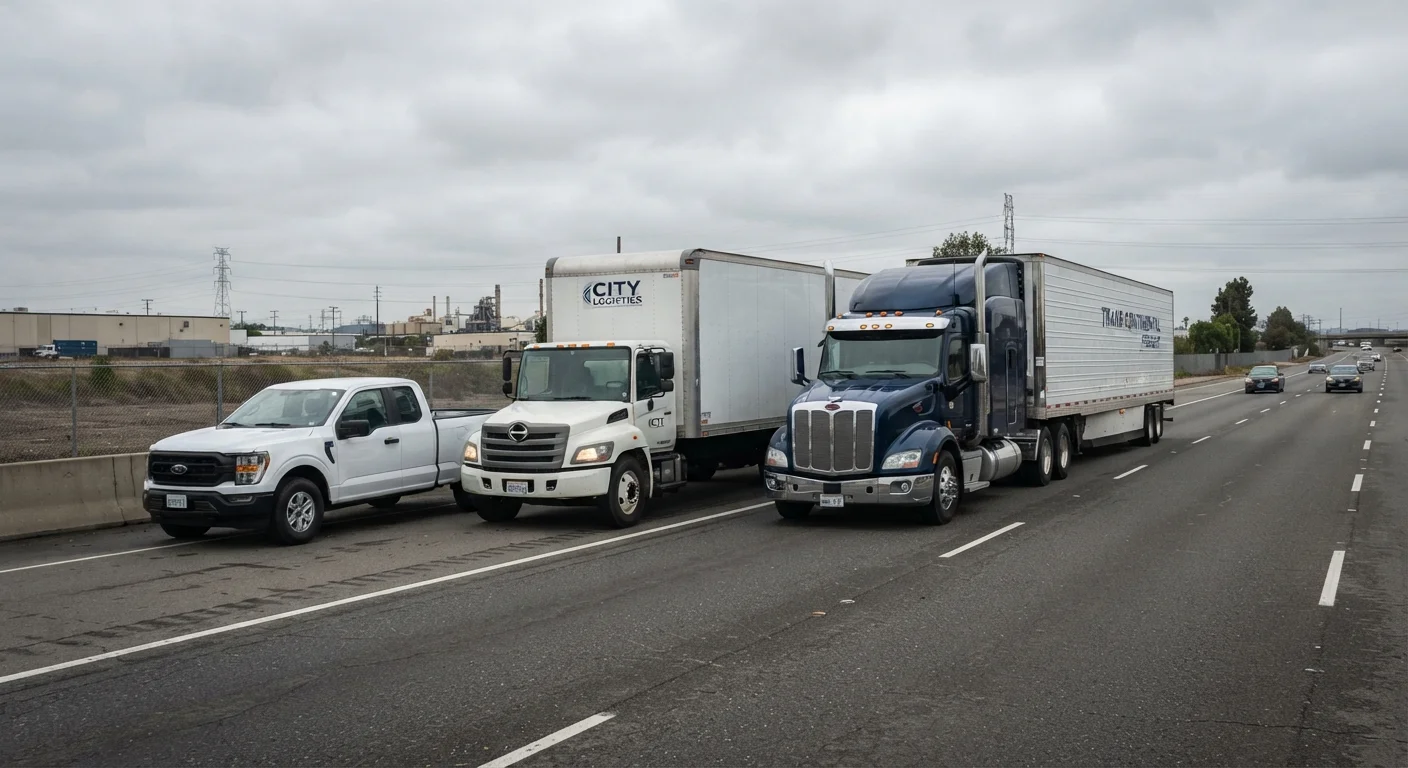
The Federal Highway Administration uses eight weight classes to categorize trucks, with Classes 1–3 covering light duty, Classes 4–6 covering medium duty, and Classes 7–8 covering heavy duty. These distinctions affect fuel economy standards, commercial driver licensing thresholds, and even how a vehicle is registered and taxed at the state level.
For a broader look at how all vehicle types are organized, see our map of American vehicle types. If you're planning to tow, understanding these classifications in tandem with GVWR and payload ratings is essential — our guide to towing capacity and GVWR explains those numbers in depth.
Light-Duty Trucks: Classes 1–3
Light-duty trucks carry a GVWR of up to 14,000 pounds and represent the vehicles most consumers interact with daily. Class 1 covers trucks up to 6,000 lbs GVWR; Class 2 runs from 6,001 to 10,000 lbs; Class 3 extends to 14,000 lbs. The familiar half-ton, three-quarter-ton, and one-ton designations used in pickup marketing broadly align with Classes 1, 2, and 3, though those "ton" labels are largely historical and no longer reflect actual payload capacity.
Standard consumer pickups — including extended-cab and crew-cab configurations — fall within this range. So do most full-size vans and some smaller work trucks. A standard driver's license is sufficient to operate these vehicles in all U.S. states. Pickup trucks in this class consistently rank among the best-selling vehicles in the country, reflecting their versatility across personal, recreational, and job-site uses.
GVWR
Gross Vehicle Weight Rating — the maximum allowable total weight of a fully loaded vehicle, including passengers, cargo, and the vehicle itself. Assigned by the manufacturer and used as the primary basis for federal truck classification.
GCWR
Gross Combined Weight Rating — the maximum total weight of a towing vehicle plus a loaded trailer. This figure matters for commercial trucking regulations and safe towing calculations.
Payload Capacity
The maximum weight of cargo and passengers a truck can carry above its own curb weight. Payload is calculated by subtracting the truck's curb weight from its GVWR.
Commercial Driver's License (CDL)
A federally required license to operate large commercial vehicles. A CDL is generally required for vehicles with a GVWR above 26,000 pounds, with additional endorsements for specific cargo types.
Half-Ton / Three-Quarter-Ton / One-Ton
Historical marketing designations loosely corresponding to Classes 1, 2, and 3. These labels originated from older payload limits but no longer accurately reflect actual payload capacity in modern trucks.
Medium-Duty Trucks: Classes 4–6
Medium-duty trucks span a GVWR range of 14,001 to 26,000 pounds, covering a broad tier of commercial workhorses. Class 4 vehicles (up to 16,000 lbs) include larger box trucks and step vans; Class 5 (up to 19,500 lbs) encompasses city delivery trucks and some crew-cab chassis; Class 6 (up to 26,000 lbs) covers medium box trucks and large utility vehicles.
At the upper end of this range — specifically above 26,001 lbs GVWR — a Commercial Driver's License (CDL) becomes federally required. Class 6 vehicles sit just below that threshold, meaning many medium-duty trucks can still be operated with a standard license, which is one reason they appeal to small businesses. Cargo and passenger vans frequently occupy the lower end of the medium-duty range; their capabilities are often underestimated relative to their size.
26,001 lbs
GVWR threshold requiring a CDL
Per Federal Motor Carrier Safety Administration regulations, commercial operators of vehicles above this weight must hold a valid CDL.
8 Classes
Federal truck weight classifications
The Federal Highway Administration's eight-class system is the standard framework used by regulators, manufacturers, and fleet operators across the U.S.
80,000 lbs
Standard max GCWR on U.S. Interstates
Federal law sets this limit for combination vehicles on Interstate highways; special permits allow heavier loads on designated routes.
Heavy-Duty Trucks: Classes 7–8
Class 7 trucks have a GVWR from 26,001 to 33,000 pounds and include city transit buses, larger refuse trucks, and heavy-spec work trucks. Class 8 — the highest designation — covers any truck with a GVWR above 33,001 pounds. This is the realm of semi-trucks, tractor-trailers, cement mixers, and fire apparatus. Operating a Class 8 vehicle commercially requires a CDL, and certain configurations carrying hazardous materials demand additional endorsements.
Gross Combined Weight Rating (GCWR), which accounts for both the tractor and a loaded trailer, can push well past 80,000 pounds on federal highways — the standard Interstate weight limit — though permits exist for heavier loads. These vehicles are subject to federally mandated hours-of-service rules, electronic logging device requirements, and regular DOT inspections. The engineering demands at this scale are entirely different from anything in the consumer truck segment.
It's also worth noting that the "heavy-duty" label applied to consumer pickups in marketing copy is not the same as federal Class 7–8 heavy duty. Segment labels can be misleading, and cross-referencing GVWR figures against the federal classification system will always give a more accurate picture than marketing terminology alone.
"Heavy-Duty" in Ads vs. Federal Classification
Consumer truck advertising frequently uses "heavy-duty" to describe three-quarter-ton and one-ton pickups, which actually fall within the federal Class 2–3 light-duty range. This can cause genuine confusion when cross-shopping or evaluating towing and payload claims. Always check the vehicle's GVWR against the federal class definitions rather than relying on a marketing label to determine a truck's true capability tier.