

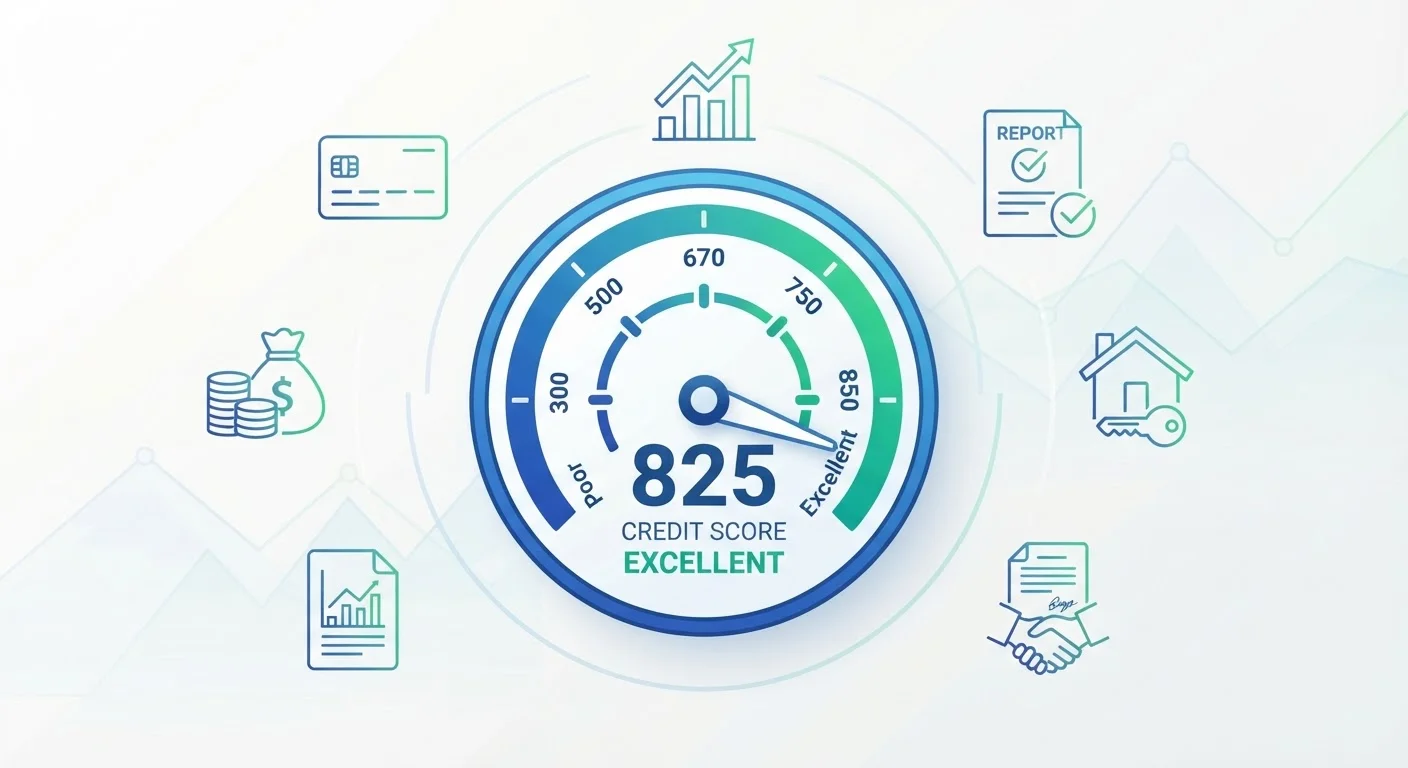
What a Credit Score Actually Represents
A credit score is not a measure of your net worth, your income, or your financial sophistication. It is a statistical estimate of one specific thing: the probability that you will repay a debt as agreed. Scoring models are built by analyzing the credit histories of millions of borrowers and identifying which behaviors most reliably predict repayment — or default. Your score reflects where your own history places you on that risk spectrum.
This is why lenders care so much about the number. When a bank evaluates a mortgage application or a card issuer considers a new account, they need to make a quick, consistent judgment about risk. A standardized score lets them do that efficiently across thousands of applicants. It doesn't capture everything about your financial life — notably, it omits income, assets, and debt-to-income ratio, which lenders often evaluate separately — but it does condense years of credit behavior into a single, comparable data point.
Credit Scores Don't Measure Wealth
It's a common misconception that a high credit score means someone is financially well-off. Income, savings, and net worth play no role in the calculation. A high earner with erratic payment habits can have a lower score than a moderate earner who pays every bill on time. The score measures credit behavior, not financial status.
The Five Factors Behind the Number
Most major scoring models weigh the same core categories, though the exact percentages vary. Under the FICO model, the breakdown is well-documented:
- Payment history (~35%): Whether you pay on time. Even one 30-day late payment can meaningfully lower a score.
- Amounts owed (~30%): How much of your available revolving credit you're using — known as credit utilization. See our article on credit utilization for a deeper look at this factor.
- Length of credit history (~15%): How long your accounts have been open, including the age of your oldest account and the average age across all accounts.
- Credit mix (~10%): Whether your history includes a variety of account types — credit cards, installment loans, mortgages — rather than just one kind.
- New credit (~10%): Recent applications for credit, measured by hard inquiries and new account openings.
Together, these factors paint a picture of how responsibly and consistently you've used credit over time. The heaviest weights sit on the behaviors that most directly predict default risk: whether you pay, and how much you owe relative to your limits.
Where Your Score Comes From
Your credit score is not stored somewhere on its own — it is generated each time it is requested, calculated from the data currently in your credit report. That report, maintained by the three major bureaus (Equifax, Experian, and TransUnion), records your account history, balances, payment record, and public financial events such as bankruptcies.
Because the bureaus may hold slightly different data — not every lender reports to all three — your score can vary depending on which bureau's report is used and which scoring model is applied. This is normal and expected. Understanding the difference between the report and the score is important; our explainer on credit reports vs. credit scores breaks down how each works and why both matter.
300–850
FICO Score range used by most US lenders
The FICO Score, the most widely used credit scoring model in the United States, operates on a 300–850 scale, with higher scores indicating lower credit risk.
~35%
Weight given to payment history in FICO scoring
According to FICO's published model breakdown, payment history is the single largest contributor to a score, making on-time payments the most impactful habit a borrower can maintain.
3
Major credit bureaus reporting US consumer data
Equifax, Experian, and TransUnion each independently maintain credit files on US consumers, which is why scores can differ depending on which bureau a lender queries.
How Lenders Interpret the Score
Lenders don't just check whether you cross a threshold — they use score ranges to set terms. A borrower with a score in the upper tier may qualify for lower interest rates, higher credit limits, and better loan terms than someone with a score 100 points lower. The difference in total interest paid over the life of a mortgage or auto loan can be substantial, even if both borrowers qualify for the same product.
It's also worth knowing that lenders are not required to use any single scoring model. A mortgage lender may use older FICO versions required by government-sponsored enterprises; an auto lender might use an industry-specific model that weights auto loan history more heavily. The score you see on a consumer app may not be the exact number a specific lender pulls. The underlying behaviors driving that number, however, affect all versions similarly.
For a broader picture of what shapes lender decisions — beyond your score alone — see our piece on how debt-to-income ratio affects lending offers.
Review Your Credit Report Regularly
Because your score is generated from your credit report, errors in that report can unfairly lower your number. US consumers are entitled to free credit reports from each of the three major bureaus through AnnualCreditReport.com. Reviewing your report periodically lets you catch inaccuracies and dispute them before they affect a loan application. See our guide to reading your credit report for a section-by-section walkthrough.
Common Misunderstandings Worth Correcting
Several widespread beliefs about credit scores lead people to make counterproductive decisions. Among the most common: that carrying a small balance on a credit card helps your score (it doesn't — paying in full is better), or that closing old accounts is harmless (it can shorten your credit history and reduce available credit). Our dedicated article on credit score myths examines these and other misconceptions in detail.
Understanding what a score actually measures — and what it doesn't — is the foundation for making smarter decisions about credit. A score is a tool that reflects past behavior and informs future borrowing. Managing it well is less about tricks and more about consistent, predictable habits over time.
This article is for general informational purposes only and does not constitute personalized financial or legal advice. Consult a qualified financial professional for guidance specific to your situation.