
Why These Three Protocols Matter
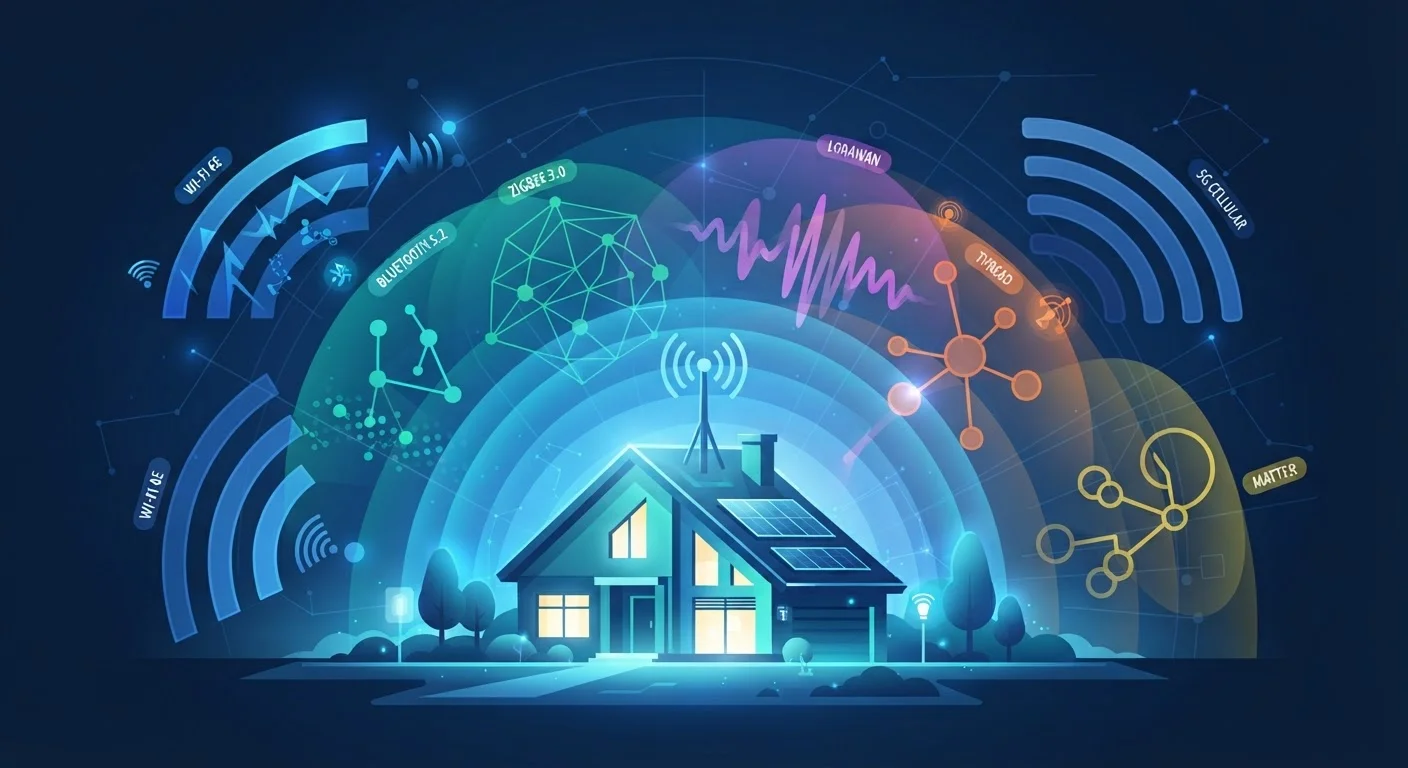
When you buy a smart bulb, door lock, or thermostat, the box usually lists a protocol name in small print. Wi-Fi and Zigbee get most of the attention, but Thread, Bluetooth Mesh, and Z-Wave quietly power a significant share of devices on store shelves today. Understanding what each one actually does helps you avoid compatibility headaches before you buy.
This glossary defines each protocol, explains how it moves data around your home, notes its typical range, and flags the device categories where it shows up most. For a broader view of how all major smart home protocols fit together, see Smart Home Ecosystems Explained.
| Thread frequency | 2.4 GHz (IEEE 802.15.4) (Thread Group specification) |
| Z-Wave US frequency | ~908 MHz (Z-Wave Alliance) |
| Bluetooth Mesh standardized | 2017 (Bluetooth SIG) |
| Z-Wave max hops per path | 4 hops (Z-Wave Alliance specification) |
| Thread application layer | Requires Matter (or another app layer) (Thread Group / CSA) |
| Hub required | Z-Wave: yes; Thread: Border Router; BT Mesh: optional |
Thread
What it is: Thread is an IPv6-based, low-power mesh networking protocol designed specifically for smart home devices. Developed by the Thread Group (a consortium that includes major tech manufacturers), it runs on the same 2.4 GHz radio frequency as Zigbee and uses the IEEE 802.15.4 standard at the radio layer.
How it works: Thread forms a self-healing mesh — if one device goes offline, traffic automatically reroutes through other nodes. Every Thread network requires a Border Router, a device that bridges the Thread mesh to your home's IP network and the internet.
Typical range: Roughly 10–30 meters per hop indoors; the mesh extends total coverage across a home as more devices are added.
Key characteristic: Thread does not define an application layer on its own — it is a transport. The Matter standard (backed by Apple, Google, Amazon, and others) runs on top of Thread to provide the interoperability layer that lets devices from different brands talk to each other.
Common device types: Smart speakers with built-in Border Routers, thermostats, door locks, and sensors from ecosystem-aligned manufacturers.
Mesh network
A network topology where each device can relay data for other devices, creating multiple paths for signals to travel. This makes the network more resilient — if one node fails, traffic reroutes automatically.
Border Router
A device that connects a Thread mesh network to a standard IP network (such as your home Wi-Fi). It acts as the bridge between Thread devices and the broader internet.
IEEE 802.15.4
A wireless communication standard defining the physical and data-link layers for low-rate wireless personal area networks. Both Thread and Zigbee use this standard at the radio layer.
Sub-GHz band
Radio frequencies below 1 GHz, such as the 908 MHz band used by Z-Wave in the US. These frequencies travel farther and pass through physical obstacles more effectively than 2.4 GHz signals.
Matter
An application-layer standard that enables interoperability among smart home devices from different manufacturers. Matter can run over Thread, Wi-Fi, or Ethernet as its underlying transport.
Publish-subscribe model
A messaging pattern used in Bluetooth Mesh where a device publishes a message to an address and any device subscribed to that address acts on it. This decouples senders from receivers.
Bluetooth Mesh
What it is: Bluetooth Mesh is a network topology extension of classic Bluetooth Low Energy (BLE), standardized by the Bluetooth Special Interest Group (SIG) in 2017. Unlike the point-to-point connection you use for headphones or speakers, Bluetooth Mesh lets many devices communicate with each other in a many-to-many arrangement.
How it works: Devices relay messages through a publish-subscribe model. A light switch publishes a "turn on" message; all lamps subscribed to that message ID respond. No hub is strictly required for local device-to-device communication, though a gateway is needed for remote access.
Typical range: Roughly 10–20 meters per hop indoors under real-world conditions; the mesh extends range across linked devices.
Key characteristic: Because virtually every modern smartphone supports Bluetooth, commissioning (adding) new devices is straightforward — no separate hub hardware is required to get started. This also makes Bluetooth Mesh popular in commercial lighting installations.
Common device types: Smart lighting systems (particularly large installations), occupancy sensors, and some asset-tracking tags. For help deciding whether a hub is worth adding to your setup, see what a smart home hub actually does.
Z-Wave
What it is: Z-Wave is a proprietary mesh protocol created by Zensys and now managed by the Z-Wave Alliance. It operates in the sub-gigahertz frequency band — around 908 MHz in the United States — which gives it a distinct advantage over 2.4 GHz protocols.
How it works: Like Thread and Bluetooth Mesh, Z-Wave uses a mesh topology where mains-powered devices act as repeaters to extend range. Battery-powered devices (sensors, locks) act as endpoints only. A Z-Wave controller or hub is required to manage the network.
Typical range: Up to approximately 30 meters indoors per hop, with a maximum of four hops per message path. The sub-GHz band penetrates walls and floors more reliably than 2.4 GHz signals.
Key characteristic: Z-Wave enforces strict interoperability certification — every device must pass testing before it can carry the Z-Wave logo, which historically has kept compatibility issues low. The ecosystem is large, with thousands of certified devices.
Common device types: Door locks, garage door openers, light switches, dimmers, thermostats, and security sensors. Z-Wave is especially common in professionally installed security systems.
If you're planning a new setup from scratch, building a smart home that actually works walks through how to sequence your purchases to avoid common protocol conflicts.
Protocol Overlap Is Common
Many modern smart home hubs support two or more of these protocols simultaneously. A single hub may coordinate Z-Wave locks, Thread sensors, and Bluetooth Mesh lights without any conflict at the device level. The protocols operate on different radio frequencies or use different channel schemes, so they generally coexist without interfering with each other. Always confirm hub compatibility with a specific protocol before purchasing devices.