
What Voluntourism Actually Means
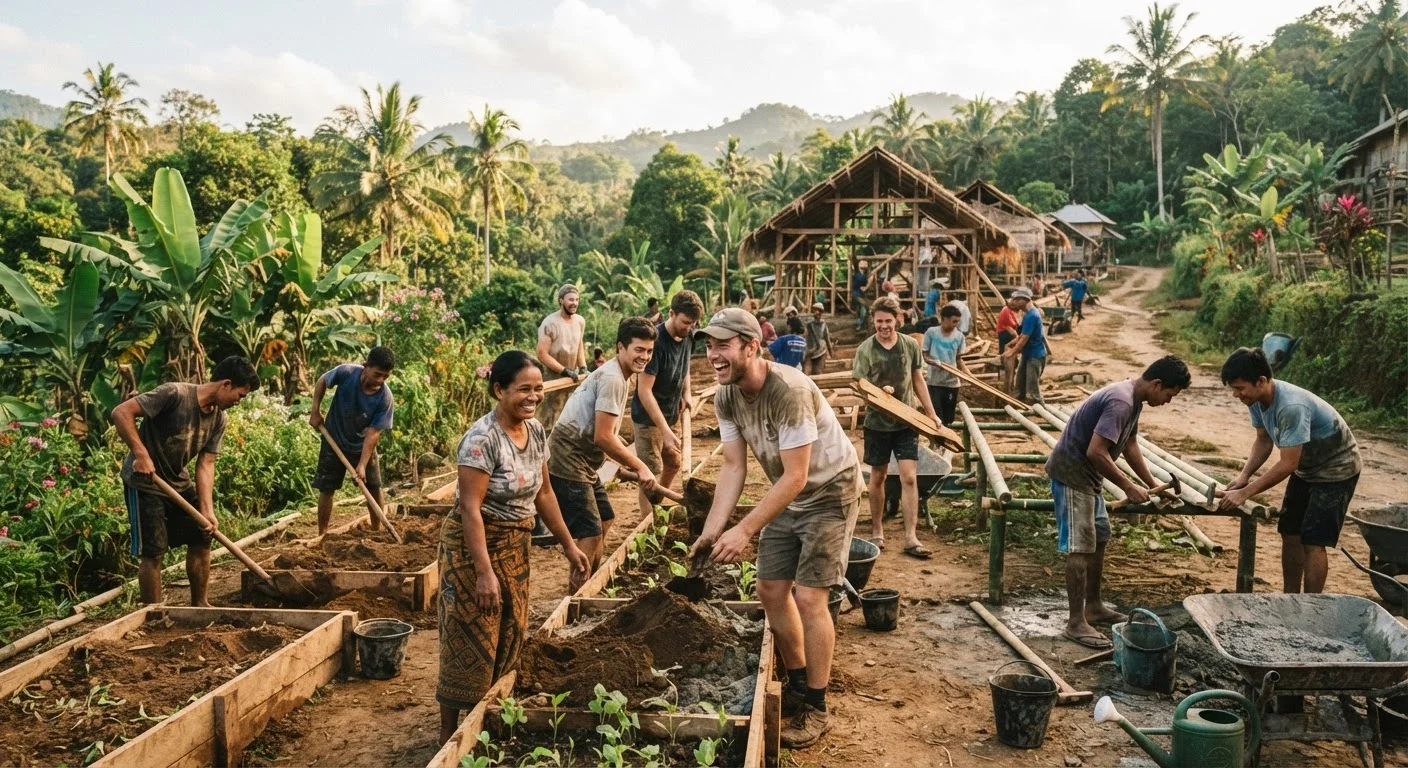
Voluntourism — the hybrid of volunteer work and international tourism — covers an enormous range of activities: building homes in Central America, teaching English in Southeast Asia, caring for wildlife in southern Africa, assisting at clinics in South Asia. The market has grown substantially over the past two decades, drawing participants from college students seeking gap-year experiences to retirees looking for purposeful travel.
What these experiences share is the premise that a traveler's time and effort, rather than — or alongside — financial donation, can address community needs. Whether that premise holds up depends on factors that rarely appear in a program's brochure. The parallels with eco travel are instructive: good intentions don't automatically translate into positive outcomes, and the gap between marketing language and on-the-ground reality can be wide.
Transfers professional skills to under-resourced communities
Medical professionals, engineers, and educators can provide expertise that is genuinely scarce in certain settings, delivering value that financial donations alone cannot replicate.
Supports long-term funding through participant networks
Returned volunteers frequently become ongoing donors and advocates for the organizations they worked with, generating sustained financial and political support beyond the placement itself.
Builds cross-cultural understanding in both directions
Well-structured programs create genuine exchange — community members and volunteers both gain perspective that can challenge assumptions and inform future decisions.
Can supplement stretched local capacity during crises
In disaster response or acute shortage contexts, coordinated volunteer deployment through established organizations has provided measurably useful short-term capacity.
Encourages deeper engagement than conventional tourism
Participants often develop a more textured understanding of a destination's social and economic realities than travelers whose itineraries center on attractions alone.
The Documented Concerns
Critics of voluntourism — including development researchers, child welfare advocates, and former volunteers themselves — have raised specific, evidence-grounded concerns that deserve serious attention rather than dismissal.
The most cited problem is the orphanage tourism phenomenon, extensively documented in sub-Saharan Africa and Southeast Asia. Investigators have found that some institutions housing children for volunteer programs are not genuine orphanages; children are sometimes recruited from families who are told their child will receive education. Demand from paying volunteers has, in documented cases, created a financial incentive to keep children institutionalized rather than in family care — an outcome directly contrary to child welfare best practices recognized by organizations including UNICEF.
A separate concern involves labor displacement. When unskilled volunteers perform construction or trade work, they may occupy roles that could otherwise provide paid employment to community members — people with stronger skills, cultural knowledge, and a long-term stake in the outcome. This dynamic is not universal, but it is common enough to warrant scrutiny of any program in which locals and volunteers are doing essentially the same tasks.
Finally, there is the problem of project discontinuity. A school wall built in phases by rotating two-week volunteers may be structurally inconsistent; a curriculum introduced by one volunteer cohort may bear no relationship to what the next group teaches. Communities can find themselves managing the expectations and learning curves of a continuous stream of strangers rather than pursuing coherent, self-directed goals.
Unskilled placements can displace local paid labor
When volunteers perform construction or service work that local workers could do — and be compensated for — the net economic effect on the community may be negative rather than positive.
Short placements rarely allow meaningful impact
Development researchers have repeatedly noted that sustainable community change requires continuity; a two-week placement typically ends before a volunteer has fully understood the context they were sent to address.
Orphanage tourism has been linked to child harm
Documented cases in multiple regions show that demand from paying volunteers has incentivized the institutionalization of children who have living family members, contravening established child welfare principles.
Program quality and accountability vary enormously
The voluntourism market includes both rigorous, community-accountable organizations and operators that function primarily as tourism businesses with humanitarian branding — and they can be difficult to tell apart.
"Voluntourist" framing can center visitor experience over community need
When programs are designed to ensure participants feel useful and fulfilled, the resulting activities may be chosen for their emotional accessibility rather than their strategic value to the host community.
Financial cost often exceeds community benefit
Program fees paid to intermediary organizations are rarely passed through in full to host communities; some analyses suggest that direct donation would deliver greater impact per dollar than participation fees do.
What Distinguishes More Defensible Programs
The concerns above are real, but they do not describe every voluntourism program. A meaningful distinction exists between programs that are community-led — where the host organization defines needs, sets the agenda, and retains control — and those that are market-led, designed primarily around what foreign participants want to experience.
Programs that tend to hold up to scrutiny share several characteristics. They require relevant, verifiable skills (medical credentials for health placements, teaching certification for classroom roles, engineering qualifications for construction). They involve longer commitments — typically several months rather than days — that allow genuine skill transfer and relationship-building. They operate through established local partners with transparent governance, publicly available financial reporting, and a track record predating the voluntourism market. And they are explicit about what volunteers will and will not do, rather than promising transformative impact from a two-week stay.
Before committing to any placement, prospective participants should ask how the program was designed (by whom, for whom), whether local staff could perform the same role, what the organization's policy is on child safeguarding, and what happens to the project when volunteer cohorts rotate. The logistics of due diligence are substantive — for a fuller picture of what vetting and pre-departure preparation involve, see the planning requirements behind volunteer travel.
A Note on Child-Focused Programs
Multiple child welfare organizations, including UNICEF and Save the Children, have issued formal guidance advising against volunteering in orphanages or residential child care facilities, particularly on short placements. Their concern is not that volunteers have bad intentions, but that demand itself can create harmful incentive structures. If a program's primary offering involves direct contact with children in residential care, that is a significant red flag worth investigating before proceeding.
The Personal Benefits — and Their Limits
It would be incomplete to discuss voluntourism without acknowledging the genuine personal value many participants report: deepened cross-cultural understanding, language acquisition, professional development in fields like public health or education, and a lasting connection to communities and causes. These outcomes are real, and for some travelers they have meaningfully redirected career paths or philanthropic giving.
The honest caveat is that personal benefit and community benefit are not the same thing — and programs optimized for the former often underperform on the latter. A traveler who gains perspective, empathy, and a powerful story to tell has still experienced a net benefit even if the community received little of lasting value. Holding both truths simultaneously is uncomfortable, but necessary for clear-eyed evaluation.
Travelers who approach voluntourism as a form of immersive education — supplementing rather than replacing direct financial support to trusted local organizations — often describe more sustainable outcomes, both for communities and for their own sense of contribution. This framing also connects to broader questions about how individual travel choices affect the places visited, a dynamic explored in our piece on how travelers contribute to or ease pressure on destinations.
~$173B
Estimated global voluntourism market value
Industry analysts have estimated the voluntourism sector at tens to hundreds of billions of dollars annually, reflecting its scale as a commercial travel category rather than a purely charitable one.
1–2 weeks
Typical volunteer placement duration
Research published in development journals has found that the majority of voluntourism placements last under two weeks — a duration most practitioners consider insufficient for substantive community impact.