
The Core Engineering Difference
Every vehicle on the road is built on one of two foundational structures: a body-on-frame design or a unibody (short for unitized body) design. The distinction shapes nearly every aspect of how a vehicle feels, performs, and holds up over time.
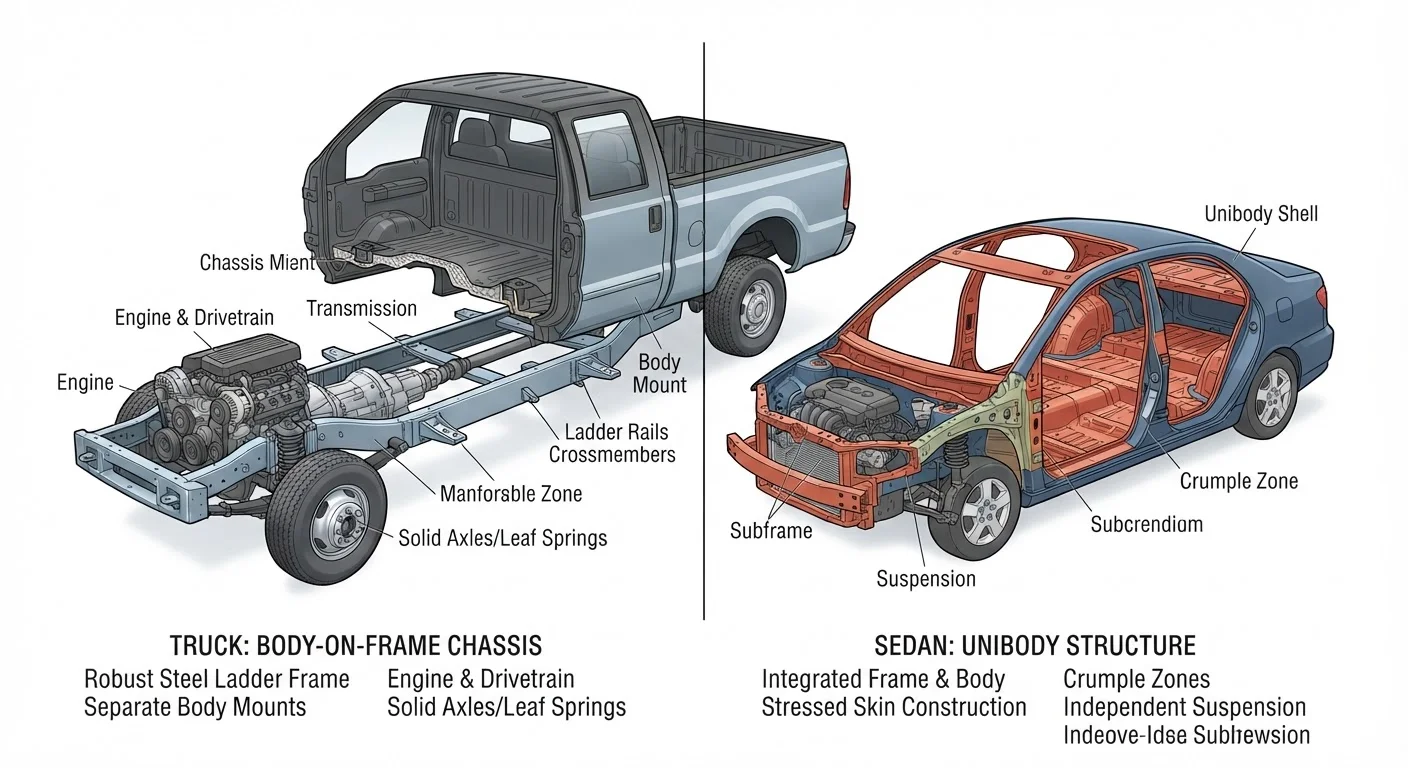
In a body-on-frame vehicle, the body — the cab, doors, roof, and interior — sits on top of a separate, rigid steel ladder frame. The frame carries the powertrain, suspension, and the structural load. The body is bolted to it, often on rubber isolators that absorb some vibration. This is the architecture behind most full-size pickups and traditional body-on-frame SUVs.
In a unibody vehicle, the body panels and structural framework are stamped, welded, and bonded into a single integrated unit. There is no separate frame — the floor pan, pillars, rails, and rocker panels all work together to bear loads. This approach dominates modern passenger cars, crossovers, and even many midsize SUVs. For a broader look at how these vehicles are categorized, see our guide to American vehicle types.
| Criterion | Body-on-Frame | Unibody |
|---|---|---|
| Structure | Separate ladder frame + mounted body | Integrated body and frame in one unit |
| Towing Capacity | Generally higher; suited for heavy loads | Moderate; varies by vehicle class |
| Ride Refinement | More isolated, can feel bouncy | Car-like, smoother on paved roads |
| Handling | Higher center of gravity, more body roll | Lower, more precise steering response |
| Fuel Economy | Typically lower due to added weight | Generally better for size class |
| Off-Road Flex | Frame flexes independently of body | Less articulation over extreme terrain |
| Crash Energy Management | Frame distributes impact rigidly | Engineered crumple zones absorb energy |
| Common Vehicle Types | Full-size trucks, large traditional SUVs | Cars, crossovers, minivans |
How Each Construction Affects Real-World Driving
The structural choice ripples through the entire driving experience in tangible ways.
Ride and Handling
Unibody construction generally produces a more refined, car-like ride. Because the structure is integrated and stiffer overall, it responds more precisely to steering inputs. Body-on-frame vehicles, by contrast, can feel more isolated — the rubber mounts between body and frame filter out vibration, which some drivers appreciate, but the result is often a higher center of gravity and more body roll in corners.
Towing and Payload
This is where body-on-frame earns its dominance in commercial and work contexts. A separate ladder frame can be engineered to withstand the sustained stress of towing heavy trailers without transferring those forces into the passenger cabin. Most Class III and above tow ratings in the U.S. market belong to body-on-frame trucks and SUVs. Unibody platforms have improved significantly — many crossover SUVs are rated to tow between 1,500 and 5,000 pounds — but they are generally not suited for the extreme payloads demanded by heavy-duty work trucks.
Fuel Efficiency and Weight
Unibody structures tend to be lighter for their size than equivalent body-on-frame platforms, which contributes to better fuel economy. The absence of a separate frame reduces the overall weight the powertrain must move. This is one reason nearly all hybrid and electric passenger vehicles use unibody construction.
~90%
Share of new passenger cars using unibody
Industry engineering analysts broadly estimate that the vast majority of modern passenger cars and crossovers sold in the U.S. are built on unibody platforms.
5,000+ lbs
Typical tow rating advantage for body-on-frame
Full-size body-on-frame pickup trucks commonly carry manufacturer tow ratings exceeding 10,000 lbs, far above most unibody crossover ratings.
Crash Safety
Modern unibody design is closely tied to engineered crumple zone technology. Specific sections of the structure are designed to deform in a controlled way during a collision, absorbing and redirecting crash energy away from occupants. Body-on-frame vehicles have improved in crash performance, but the inherent rigidity of a ladder frame distributes crash forces differently. Both construction types can achieve strong safety ratings when properly engineered, but unibody has historically dominated top scores in standardized U.S. crash testing for passenger vehicles.
Which Vehicles Use Which Construction — and Why
The split in the current U.S. market is fairly predictable once you understand what each architecture does well.
Body-on-frame persists in: full-size pickup trucks, heavy-duty trucks, traditional body-on-frame SUVs (such as large three-row SUVs built on truck platforms), and most commercial vehicles. The architecture endures because no unibody platform yet matches its sustained towing and payload capability at scale.
Unibody dominates: sedans, hatchbacks, coupes, convertibles, crossover SUVs, minivans, and the overwhelming majority of the passenger vehicle market. If you're shopping for a hatchback or sedan, you're almost certainly evaluating unibody vehicles. Even many vehicles marketed as SUVs — particularly compact and midsize crossovers — use unibody construction derived from car platforms.
The choice of architecture is rarely arbitrary. Automakers engineer each platform to match the primary demands of the intended buyer. If you're still mapping out what vehicle type fits your actual driving patterns, the framework in Choosing a Vehicle Type to Match How You Actually Drive can help clarify that before construction type becomes the deciding factor.
A Note on Classic and Vintage Vehicles
Nearly all American vehicles built before the 1970s used body-on-frame construction, and many classic trucks and muscle cars retain this architecture today. If you're working on a restoration project, the structural type matters for sourcing replacement parts and assessing frame integrity. For a look at how restoration philosophy intersects with structural decisions, see our piece on resto-mod vs. concours restoration.