
Why Delay Costs More Than the Original Repair
Not every warning light signals an emergency, and most experienced mechanics will tell you that some issues can safely wait a few weeks while others cannot. The difference lies in whether a problem is self-contained or whether it systematically degrades adjacent components the longer it runs unchecked.
Deferred maintenance is one of the most significant hidden contributors to vehicle ownership costs — a point worth understanding alongside the broader picture described in our total cost of ownership guide. The repairs below are specifically those where the cost of waiting grows exponentially, not linearly. Knowing them by name helps you make smarter triage decisions when your budget has limits.
When a Repair 'Seems Fine' for Now
Some owners delay repairs because the vehicle continues to run without obvious symptoms. This is especially common with coolant leaks, CV boots, and brake fluid degradation — issues that worsen gradually rather than triggering immediate performance changes. The absence of a noticeable symptom does not mean a problem is stable; it often means the damage is accumulating out of sight.
Repairs With the Steepest Cost of Delay
Coolant System Leaks
A small coolant leak — even one that only drops the reservoir a fraction of an inch per week — can escalate into a catastrophic engine failure if the engine overheats. Coolant regulates engine temperature, and once the system runs low, heat builds rapidly. Sustained overheating warps cylinder heads, destroys head gaskets, and can crack the engine block itself. A minor hose replacement or clamp tightening that might cost under $200 can, if ignored, result in a head gasket repair costing $1,500–$2,500 or an engine replacement running $4,000 or more.
Watch for a sweet smell near the engine, white smoke from the exhaust, or a reservoir that needs regular topping off — any of these warrants prompt attention.
A minor coolant hose replacement left too long can escalate into a $4,000 engine replacement.
Timing Belt or Timing Chain Wear
The timing belt (or chain) synchronizes the rotation of the crankshaft and camshaft, controlling when valves open and close. Most manufacturers specify replacement intervals between 60,000 and 100,000 miles for belts. When a timing belt fails — often without warning — it typically causes what's called an interference engine failure: the pistons and valves collide, bending valves and sometimes damaging pistons and the cylinder head. The difference between proactive replacement (roughly $500–$1,000 including water pump) and reactive engine repair (often $3,000–$8,000 or more) is stark. Timing chains are more durable but can stretch and skip, with similarly expensive results if ignored.
Timing belt replacement on schedule is one of the highest return-on-investment maintenance tasks a vehicle owner can perform.
Brake Fluid Degradation
Brake fluid is hygroscopic, meaning it absorbs moisture from the air over time. As water content increases, the fluid's boiling point drops. Under hard braking, degraded fluid can vaporize inside the lines — a condition called vapor lock — causing a sudden and dangerous loss of braking force. Beyond safety, water-contaminated fluid accelerates corrosion inside calipers, wheel cylinders, and ABS modulators. A brake fluid flush typically costs $80–$150; replacing a corroded ABS modulator can exceed $1,000. Most manufacturers recommend flushing every two to three years regardless of mileage.
Brake fluid degradation is a safety issue first — and an expensive parts-replacement issue second.
Oil Leaks That Contact Rubber Components
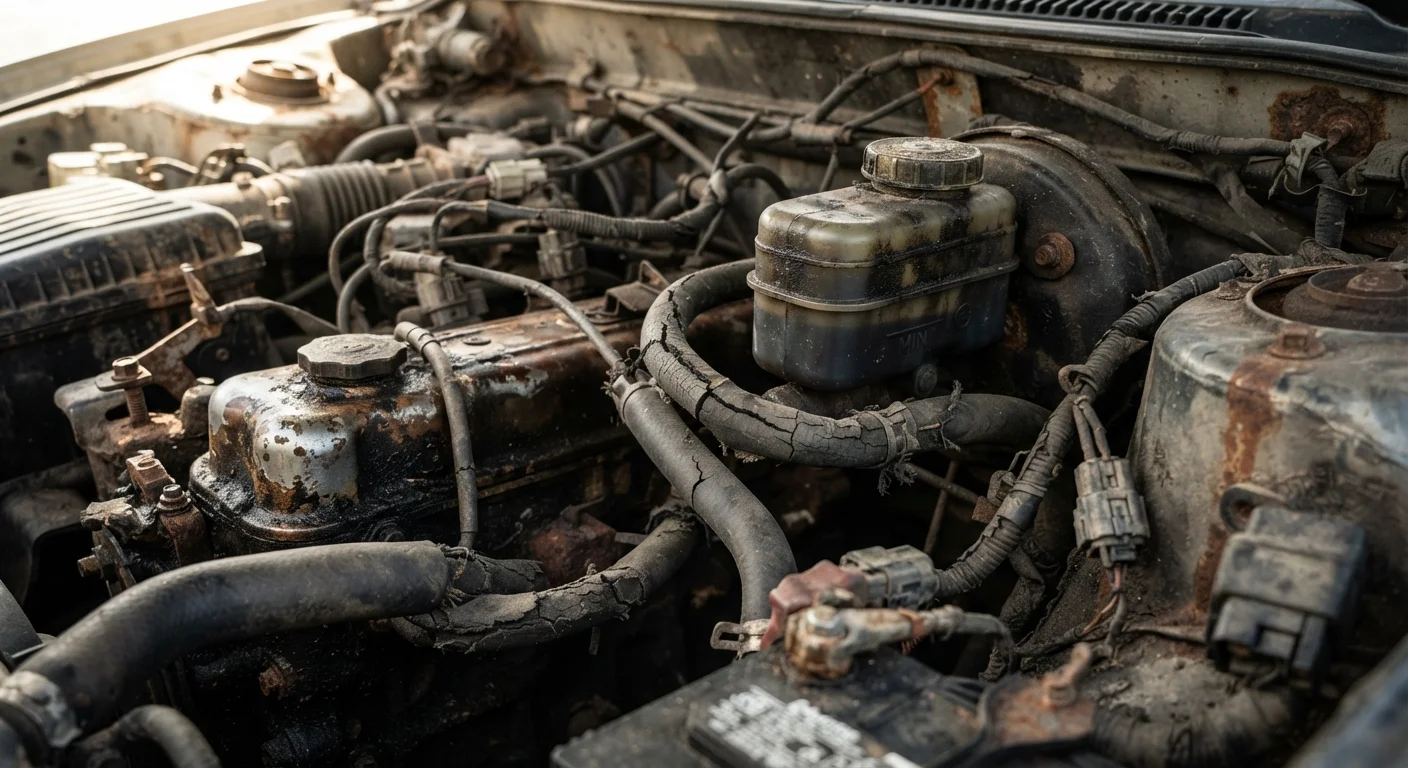
Not all oil leaks are equal. A slow seep from a valve cover gasket is far less urgent than a leak that allows oil to contact accessory drive belts, timing belt covers, or engine mounts. Oil dissolves the rubber compounds in belts and bushings, causing accelerated cracking and premature failure. An engine mount soaked in oil may fail within months rather than years, allowing the engine to shift under load and potentially damaging wiring harnesses and hoses. Addressing the source leak promptly — and replacing any oil-contaminated belts at the same time — prevents a compounding sequence of failures.
Oil-soaked belts and mounts degrade far faster than dry ones — the leak and its collateral damage both need attention.
Worn or Cracked CV Axle Boots
Constant velocity (CV) axle boots are rubber covers that keep grease around the CV joint while keeping contaminants out. When a boot cracks, the grease escapes and road grit enters. A joint that is properly greased can last the life of the vehicle; a joint running dry and contaminated typically fails within 10,000–20,000 miles. Replacing just the boot while the joint is still serviceable costs $150–$300. Waiting until the joint fails means replacing the entire axle shaft, usually $400–$800 per side, plus the risk of stranding the vehicle or losing control if the joint separates while driving. A torn boot is often visible during a routine inspection.
Catching a cracked CV boot before the joint fails is one of the clearest examples of a $200 fix preventing a $700 repair.
Deferred Rust Treatment on Structural Panels
Surface rust that hasn't yet penetrated the metal can often be halted with preparation, primer, and protective coating at relatively low cost. Once rust perforates a panel and reaches structural components — frame rails, unibody floor pans, suspension attachment points — the repair calculates differently. Structural rust can compromise crash safety, fail state inspections, and in severe cases render a vehicle uneconomical to repair. This concern applies acutely to classic and vintage vehicles, where original sheet metal is irreplaceable. Addressing surface rust annually, particularly in regions that use road salt, is among the most cost-effective forms of preventive maintenance available.
Surface rust treated early is a minor expense; structural rust left unchecked can total an otherwise sound vehicle.
Build a Priority Repair List at Each Service Visit
Ask your mechanic to categorize recommended repairs as safety-critical, compounding-risk, or cosmetic and stable. This gives you a defensible framework for sequencing repairs when you can't address everything at once. Compounding-risk items — those that damage adjacent components over time — should generally come before purely cosmetic concerns, regardless of relative cost.
Making Smarter Repair Decisions
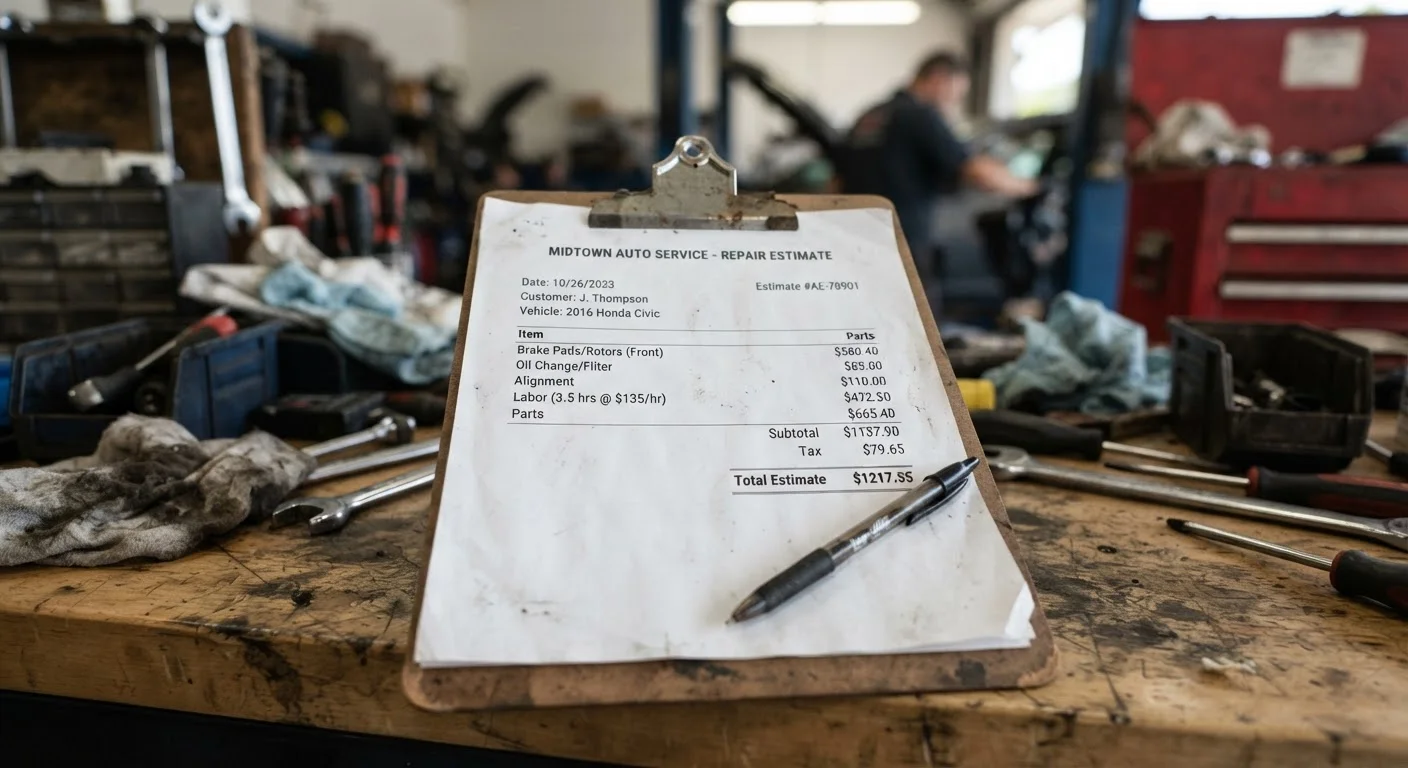
When a shop presents you with a list of recommended repairs, understanding which items on that list have compounding consequences gives you a rational basis for prioritization. Before approving any estimate, it's worth reviewing how to read a repair estimate without getting lost so you fully understand what you're authorizing and why. You can also consult our guide on questions worth asking your shop before approving a repair to make sure nothing critical is being understated.
If you're considering trading in a vehicle with deferred maintenance, be aware that unresolved issues almost always surface during dealer inspection and reduce your offer — sometimes by more than the repair would have cost. Our trade-in pitfalls guide covers how to avoid that outcome.
This article is for general informational purposes only. Repair timelines, severity, and costs vary by vehicle make, model, age, and condition. Consult a qualified mechanic for diagnosis and advice specific to your vehicle.