
Overview of the Development Process
Property development converts raw land or underused buildings into finished, income-producing or saleable assets. The process is sequential but rarely linear — delays in planning can push back financing, and market shifts can trigger redesigns mid-way through construction.
For a foundational understanding of who drives these projects and what the overall arc looks like, see Property Development Explained: From Raw Land to Finished Building. If unfamiliar terminology comes up as you read, Key Terms Every Property Development Beginner Should Know provides definitions for concepts like entitlements, cap rates, and absorption rates.
The six stages below reflect the typical progression of a U.S. ground-up development project. Timelines and complexity vary significantly by asset type, jurisdiction, and market conditions.
2–7 years
Typical ground-up development timeline
Industry practitioners generally estimate that a ground-up project — from site control to stabilization — takes between two and seven years depending on project scale and regulatory environment.
5–10%
Recommended hard-cost contingency reserve
Construction industry guidelines commonly suggest reserving 5–10% of hard costs as contingency to absorb unforeseen conditions and scope changes.
90–95%
Typical stabilized occupancy threshold
Most construction lenders and institutional investors define a stabilized rental asset as one achieving 90–95% occupancy, after which permanent financing can be secured.
Stage 1: Site Identification and Acquisition
Every project begins with locating a site that matches a development strategy. Developers evaluate location fundamentals — proximity to infrastructure, demographics, zoning classification, and comparable market activity — before making any offer.
Once a candidate site is identified, the developer typically enters a purchase and sale agreement with an inspection or due diligence contingency, giving them a defined window to investigate the property before committing fully. Some developers use an option agreement instead, paying a fee for the right to purchase at a set price within a future period — preserving capital while entitlements are pursued.
Skipping Due Diligence Is Costly
Waiving or shortening the due diligence period to win a competitive deal can expose a developer to significant undiscovered liabilities — including environmental contamination, title defects, or unsuitable soil conditions. The cost of thorough investigation is almost always far less than the cost of discovering a problem after closing.
Stage 2: Due Diligence and Feasibility
Due diligence is the structured investigation period during which the developer stress-tests every assumption. Key workstreams include:
- Title and survey review — confirming ownership, easements, encumbrances, and boundary lines
- Environmental assessment — Phase I (records review) and, if red flags appear, Phase II (physical testing) to identify contamination or hazards
- Geotechnical study — soil and subsurface conditions that affect foundation design and cost
- Zoning and entitlement analysis — confirming what can legally be built and what approvals will be required
- Financial feasibility modeling — projecting hard costs, soft costs, revenue, and return metrics
If feasibility analysis reveals that projected returns do not meet the developer's threshold — accounting for risk — the deal is typically abandoned before significant capital is deployed. This discipline is what separates viable projects from costly mistakes.
Model your feasibility analysis with at least three scenarios — base case, downside, and stress case — before signing a purchase contract. A deal that only works under optimistic assumptions is a deal that carries hidden risk.
Development projects routinely encounter cost overruns, entitlement delays, or softening markets. Scenario modeling surfaces these risks before capital is committed, when the developer still has the option to walk away at low cost.
Engage a land use attorney early in the entitlement process — ideally before submitting any applications. Their familiarity with local planning staff and precedent can meaningfully shorten approval timelines.
Entitlements are the most time-sensitive and jurisdiction-specific phase of development. Local expertise frequently reduces costly rework and hearing continuances.
Stage 3: Planning, Entitlements, and Design
Entitlements are the governmental approvals that authorize a specific type and scale of development on a given parcel. Depending on jurisdiction and project complexity, this phase can include rezoning applications, conditional use permits, environmental impact review, design review board approval, and public hearings.
Entitlement timelines vary widely — from a few months in straightforward jurisdictions to several years in densely regulated markets. This uncertainty is one of the most significant risk factors in development, because carrying costs accrue and market conditions can shift during the wait.
Simultaneously, the development team advances design from conceptual sketches through schematic design, design development, and ultimately construction documents. The Roles Involved in a Property Development Project explains how architects, planners, and civil engineers collaborate during this phase.
Entitlements Are Not Guaranteed
Receiving planning approval is never certain, regardless of how well a project aligns with existing zoning. Community opposition, environmental review findings, or policy changes can slow or block a project at any point in the approval process. Developers should factor entitlement risk into their financial models and legal agreements — and consult qualified land use counsel before making significant capital commitments based on anticipated approvals.
Stage 4: Financing and Pre-Construction
Once entitlements are secured (or sufficiently advanced), the developer finalizes the project's capital structure. Most ground-up projects combine senior construction debt with equity — either the developer's own capital, joint venture equity, or funds from limited partners.
Construction lenders typically require the developer to contribute a meaningful equity percentage before funding begins, and they release loan proceeds in draws tied to verified construction milestones rather than as a lump sum. For a detailed look at how this financing architecture works, see How Property Developers Finance a Project.
Pre-construction activities also include bidding and awarding general contractor contracts, finalizing construction documents, pulling building permits, and establishing the construction schedule.
Stage 5: Construction
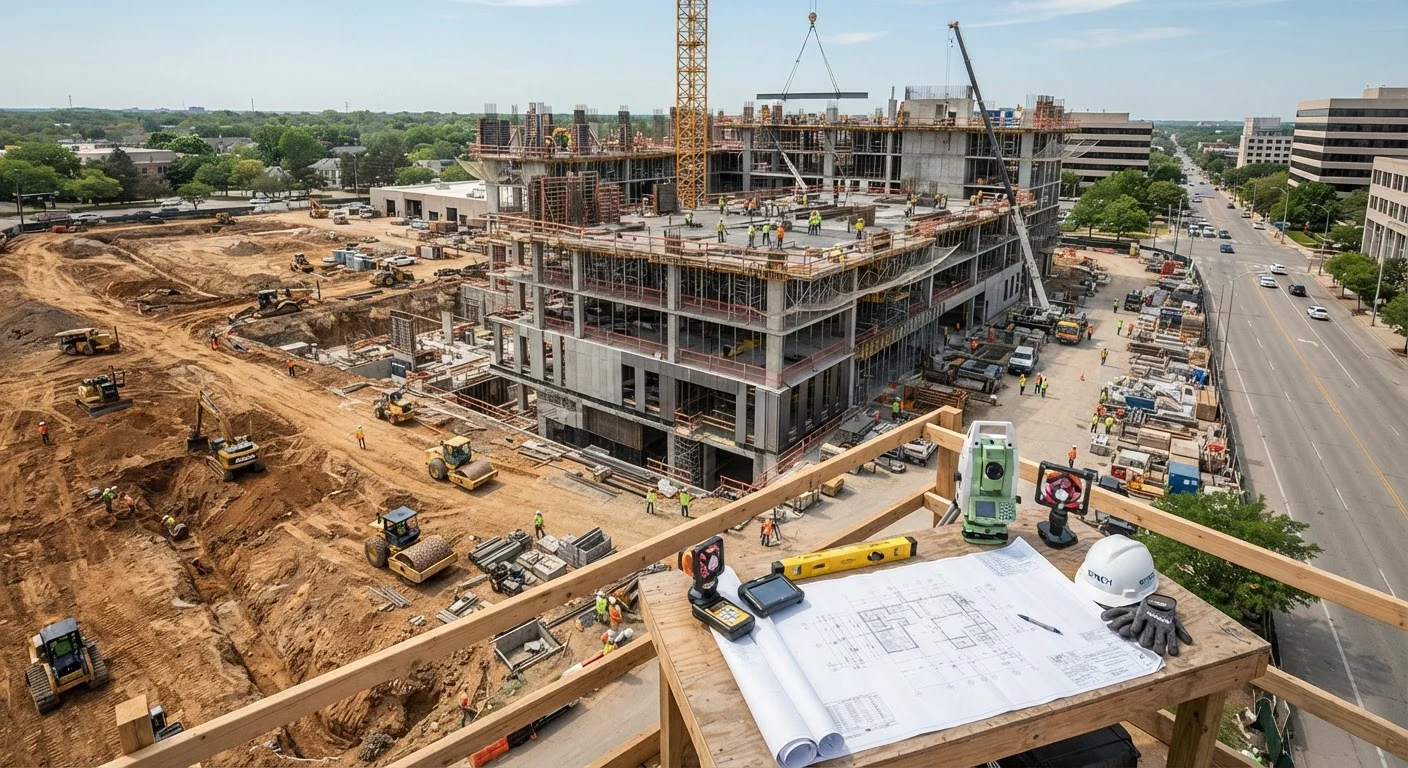
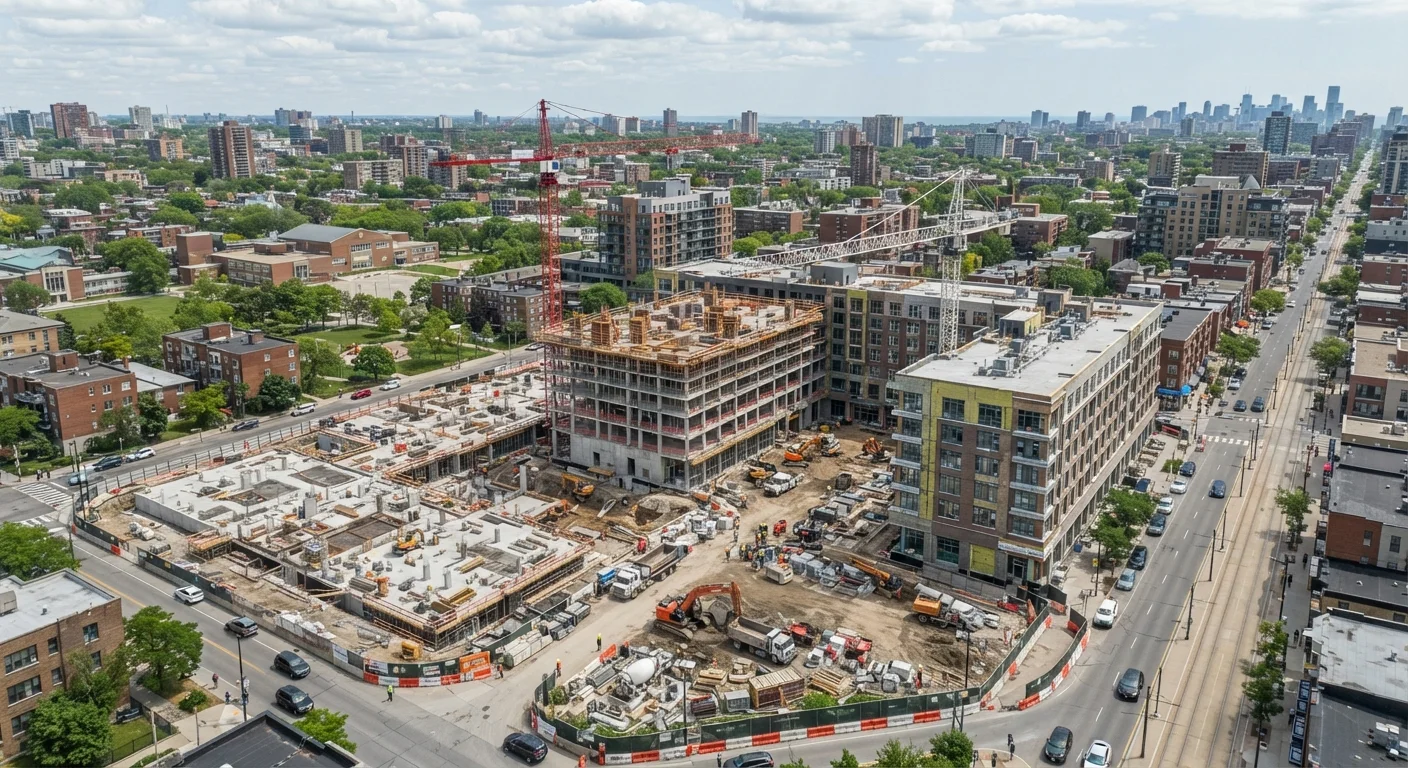
With permits in hand and financing closed, vertical construction begins. The developer or an owner's representative monitors progress, quality, and budget through regular site visits and draw reviews. Key milestones typically include:
- Site work and foundation — grading, utilities, and footings
- Structural framing — the building's skeleton reaches full height
- Mechanical, electrical, and plumbing rough-ins — systems installed before walls close
- Envelope completion — roof, windows, and exterior cladding
- Interior finishes — flooring, cabinetry, fixtures, and paint
- Final inspections and certificate of occupancy — local authorities confirm the building meets code
Budget overruns and schedule delays are common. Contingency reserves — typically 5–10% of hard costs for well-defined projects — are built into budgets precisely to absorb these variances without derailing the project.
Track Draws Against a Master Budget
Establish a line-item budget before construction begins and reconcile every draw request against it. Catching cost creep early — rather than at project completion — gives developers and lenders the opportunity to course-correct before contingency reserves are exhausted.
Stage 6: Completion, Handover, and Stabilization
A certificate of occupancy (CO) signals that the building is legally habitable, but the project is not financially complete until units are leased or sold. For rental projects, stabilization — reaching a target occupancy level, commonly 90–95% — is the benchmark lenders and investors use to evaluate project success. For-sale projects measure success through absorption, the pace at which units sell.
During this phase, construction loans are typically refinanced into permanent debt once the asset is stabilized. The process of transferring the asset to its permanent operating state may involve navigating escrow for individual unit sales or portfolio-level transactions.
Urban Land Institute (ULI)
ULI publishes research, case studies, and educational resources on real estate development practice across asset types and markets. Useful for understanding industry benchmarks and best practices.
How Property Developers Finance a Project
A companion article explaining construction loans, equity structures, and capital stacks — the financial architecture that makes a development project possible.
The Roles Involved in a Property Development Project
Breaks down the responsibilities of developers, architects, general contractors, and lenders so readers understand how the full team operates across each development stage.
This article is for general informational and educational purposes only. It does not constitute financial, legal, or investment advice. Real estate development involves substantial risk. Consult qualified legal, financial, and real estate professionals before making any development or investment decisions.