

Overview: Why Development Requires a Team
A property development project is not the work of a single professional. From the moment a site is identified to the day a building is delivered, a layered team of specialists contributes expertise that no one individual can replicate alone. Each role addresses a distinct set of risks, regulations, and deliverables. Understanding what property development actually involves helps clarify why so many professionals are needed and how they fit together.
| Core team size | Typically 8–15 distinct professional roles |
| Who holds final authority | The property developer |
| Design lead | Licensed architect |
| Construction oversight | General contractor |
| Regulatory navigation | Land use attorney and planning consultant |
| Capital provision | Equity investors and construction lenders |
The developer sits at the center, but every other role is essential. Missing or poorly coordinated professionals are a leading reason projects stall, exceed budgets, or fail to obtain approvals. For a closer look at how these roles activate across time, see the stage-by-stage development process.
The Core Roles and What Each One Does
The Developer
The developer is the project's originator and decision-maker. They identify the opportunity, assemble the land, secure financing, hire the team, manage entitlements, and ultimately bear financial responsibility for the outcome. Developers may be individuals, private companies, or institutional entities.
Architect
A licensed architect translates the developer's vision into buildable plans. They produce schematic designs, construction documents, and coordinate with engineers to ensure the structure meets code requirements. Architects also liaise with planning authorities during the approval process.
Civil and Structural Engineers
Civil engineers design site infrastructure — grading, drainage, and utility connections. Structural engineers ensure the building's frame and foundation can safely support the intended loads. Both sets of drawings are required for permit applications.
Land Use Attorney and Planning Consultant
Securing entitlements often requires navigating complex zoning rules and land use regulations. A land use attorney provides legal representation before planning boards and in appeals, while a planning consultant advises on strategy and prepares required submissions.
Roles Can Overlap on Smaller Projects
On smaller or simpler developments, one firm may carry multiple responsibilities — for example, a design-build contractor handles both architecture and construction management. On large, complex projects, each role is typically filled by a separate, specialized party. Understanding where responsibilities begin and end is critical for accountability and risk management.
General Contractor
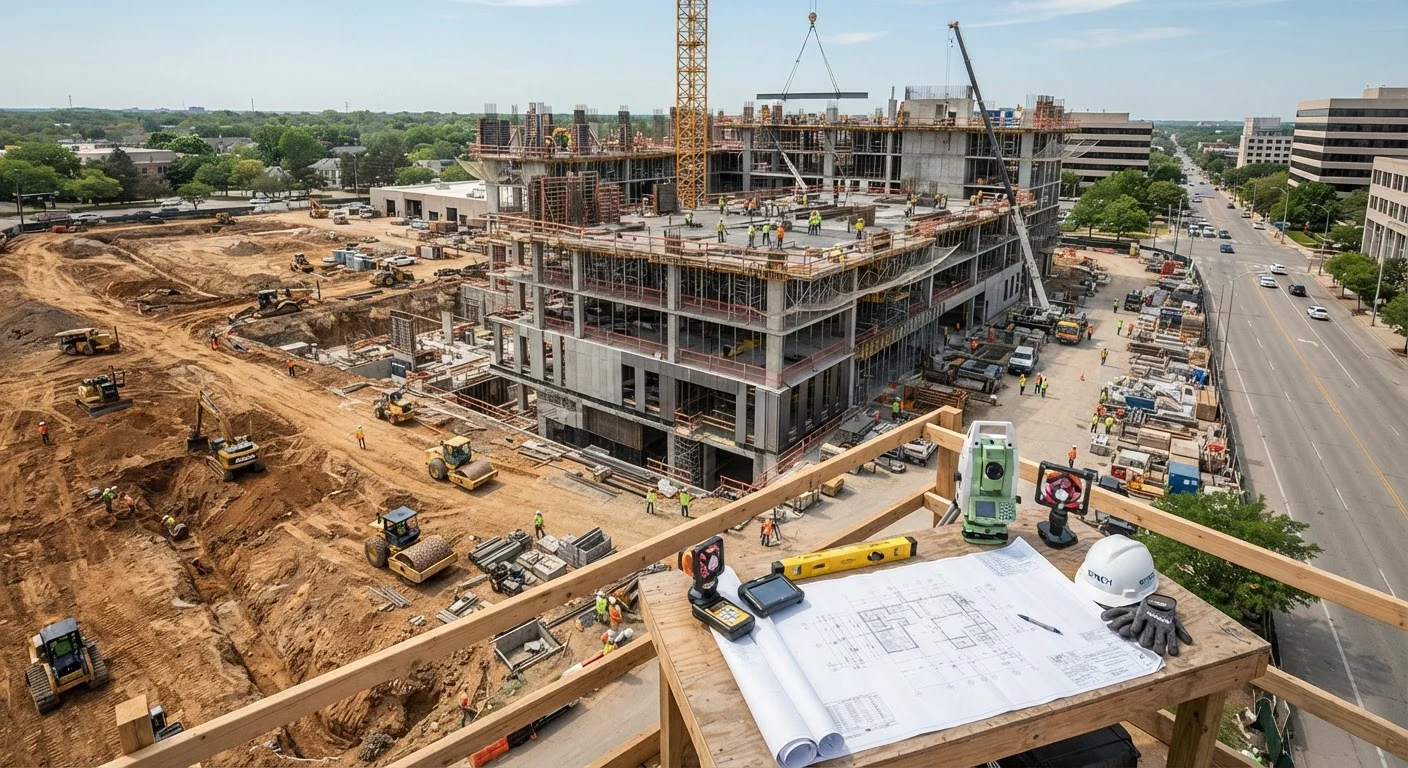
Once permits are in hand, the general contractor (GC) takes charge of physical construction. The GC hires and manages subcontractors — electricians, plumbers, framers — and is contractually responsible for delivering the project on schedule and within the agreed cost. Strong GC selection is one of the most consequential decisions a developer makes. Cost overruns often trace back to this relationship; see why development projects go over budget.
Construction Lender and Equity Partners
Development financing typically involves both debt and equity. A construction lender provides short-term capital disbursed in draws tied to milestones, while equity partners contribute capital in exchange for a share of returns. The structure of this capital stack shapes every financial decision on a project. How developers finance a project covers these arrangements in detail.
Project Manager and Quantity Surveyor
A dedicated project manager (sometimes in-house to the developer) coordinates schedules, tracks deliverables, and resolves conflicts between team members. A quantity surveyor independently monitors costs, prepares valuations for lender draw requests, and flags budget risks early.
Other Specialists
Depending on project type, additional roles may include environmental consultants, geotechnical engineers, sustainability advisors, leasing agents, and marketing professionals. Each adds targeted expertise at the stage where their input is most valuable. For a broader view of the professionals involved in property transactions generally, see the full cast of professionals in a real estate transaction.