
Know Your Hair Before You Buy Anything
Building a hair care routine that actually works starts not at the store, but with observation. Hair type — commonly described using curl pattern scales such as straight (Type 1), wavy (Type 2), curly (Type 3), and coily (Type 4) — is a useful starting point. But texture, density, and porosity (how well the hair cuticle absorbs and holds moisture) are equally important variables.
Assess your hair in its natural state after a regular wash. Is it dry within an hour, or does it stay damp for hours? Does it tangle easily? Is your scalp oily by day two? These observations shape every product and method decision that follows.
Porosity Affects Product Performance
Hair porosity — how readily the cuticle absorbs and retains moisture — is one of the most practical things to understand about your hair. Low-porosity hair resists moisture uptake but holds it well once absorbed; high-porosity hair absorbs quickly but loses moisture fast. You can get a rough read by placing a clean strand in a glass of water and observing whether it floats or sinks after a few minutes, though in-person assessment by a stylist is more reliable.
Once you understand your baseline, you're ready to build — not before. See our guide to building a morning skincare routine for a parallel framework applied to skin.
Step One: Cleansing
Shampooing removes product buildup, excess sebum, and environmental residue from the scalp. The goal is a clean scalp — not stripped, dry strands. For most people, washing two to three times per week is sufficient, though those with very oily scalps or active lifestyles may wash more frequently, and those with coily or very dry hair may wash less.
90%
Of hair strand is dead protein (keratin)
According to trichology research, the visible hair shaft is composed almost entirely of keratin, making protein balance central to hair integrity.
2–3x
Average weekly washes for most hair types
Dermatologists generally suggest that washing frequency should be guided by scalp oiliness and hair texture rather than a fixed daily schedule.
Shampoo belongs primarily on the scalp. Work it into the roots with your fingertips using gentle circular motions, then let the rinse carry diluted product through the lengths. Avoid piling hair on top of your head and scrubbing — this creates unnecessary friction and tangling.
Dilute your shampoo slightly with water before applying it to fine or color-treated hair — it distributes more evenly and reduces the risk of stripping natural oils from the mid-lengths.
Concentrated surfactants applied directly can disrupt the scalp's moisture balance, especially for hair that processes easily.
Apply conditioner from mid-length to ends first, then work upward only if your scalp is very dry — keeping conditioner off a healthy scalp prevents buildup and excess oiliness.
The oldest, most processed parts of the hair shaft — the ends — need the most moisture replenishment, while the scalp typically produces its own sebum.
Step Two: Conditioning
Conditioner replenishes moisture, smooths the cuticle, and reduces friction — making detangling easier and breakage less likely. It is not optional for most hair types. The formula works by depositing positively charged conditioning agents onto the negatively charged hair shaft, temporarily sealing the cuticle.
Apply conditioner after rinsing out shampoo, focusing on the mid-lengths and ends. Leave it on for two to three minutes before rinsing with cool or lukewarm water. Cool water helps close the cuticle and can add perceptible shine. Deep conditioning — using a richer, longer-contact formula once every one to two weeks — is appropriate for dry, color-treated, or heat-styled hair.
Start With Two or Three Products
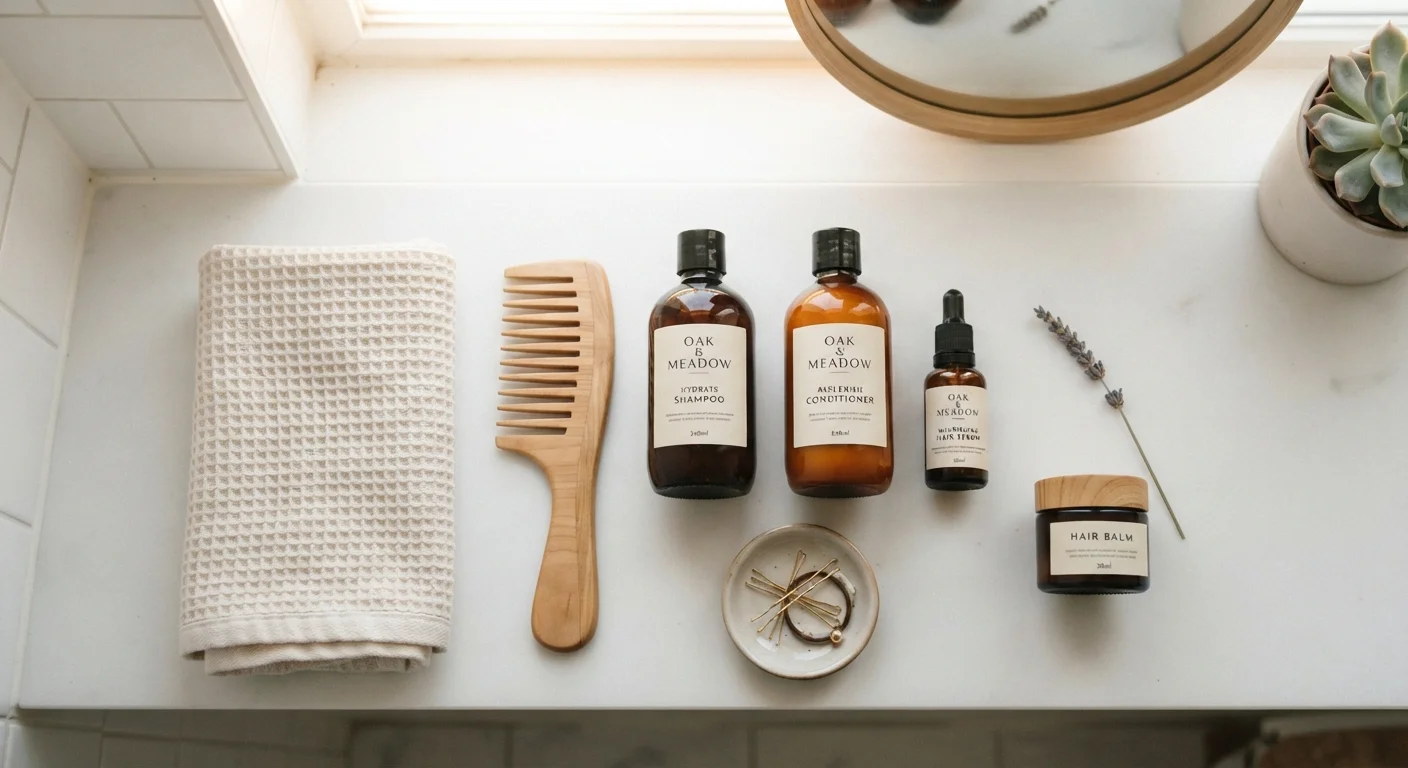
Beginning a new routine with a full shelf of products makes it nearly impossible to identify what's working. Start with a shampoo, a conditioner, and one leave-in or finishing product. Add treatments or serums only after your baseline is stable — typically after four to six weeks.
Step Three: Treatments
Treatments address specific concerns that a standard shampoo-and-condition routine can't fully resolve. The two most practical categories for a foundational routine are:
- Deep conditioners and hair masks: Intensive moisture or repair products left on for ten to thirty minutes. Useful for dry, porous, or chemically processed hair.
- Protein treatments: Formulas that temporarily reinforce the hair shaft's keratin structure. Appropriate when hair feels limp, stretchy, or prone to breakage — but overuse causes brittleness.
You don't need both weekly. Learn to read your hair's behavior: if it feels mushy and over-stretched when wet, it may need protein; if it feels rough and snaps without stretch, it may need moisture. Our companion article on protein treatments and hair care habits goes deeper on this balance.
Scalp Health Is Hair Health
The condition of your scalp directly influences how your hair grows and behaves. Persistent flaking, itching, redness, or unusual hair loss are scalp concerns — not cosmetic ones — and deserve attention from a dermatologist or licensed trichologist. No shampoo or treatment routine substitutes for professional evaluation of ongoing scalp symptoms.
Step Four: Styling Without Damage
Styling is where most routine-related damage accumulates. Heat tools, tight elastics, rough towel-drying, and brushing wet hair all stress the cuticle and cortex over time.
Heat Without Protection Compounds Quickly
Using a flat iron or blow dryer regularly without a heat protectant accelerates cuticle damage, leading to breakage and split ends over time. A heat protectant doesn't prevent all damage, but it significantly reduces the thermal stress on the hair shaft. If you notice dryness, brittleness, or excessive shedding, scale back heat use before adding more products.
Practical protective habits include:
- Blot hair dry with a microfiber towel or a soft cotton t-shirt rather than rubbing with a terrycloth towel.
- Detangle with a wide-tooth comb starting from the ends and working upward.
- Apply a heat protectant — a product containing film-forming polymers — before any hot tool use.
- Wear low-tension styles at night; satin or silk pillowcases reduce friction for all hair types.
“Healthy hair starts at the scalp. Treating the visible strand without addressing the environment it grows from is like painting over a cracked wall — it may look better temporarily, but the underlying issue remains.”
— Dominic Blake, Licensed trichologist and hair health educator
Building Consistency Into Your Routine
The most effective hair care routine is the one you actually follow. Simplicity and sustainability matter more than a comprehensive product lineup. Establish your cleanse-and-condition steps first, observe how your hair responds over four to six weeks, then layer in a treatment or styling product as needed.
Seasonal changes — particularly summer's UV exposure, humidity, and chlorine — can shift what your hair needs. Our pre-summer hair care checklist helps you anticipate those adjustments before they become damage. Likewise, if you notice persistent dryness, breakage, or scalp issues that don't resolve with routine adjustments, a licensed stylist or dermatologist can offer personalized guidance.
Hair Care Habits That Actually Matter
A focused look at evidence-backed habits — covering trimming schedules, protein treatments, and what separates real results from marketing claims.
Pre-Summer Hair Care Checklist
Practical preparation for UV exposure, chlorine, salt water, and humidity — the seasonal factors that most routines overlook.
American Academy of Dermatology – Hair Care Tips
The AAD publishes accessible, evidence-based guidance on hair washing, heat use, and common hair care mistakes — a reliable reference for any hair type.
This article provides general hair care information for educational purposes and is not a substitute for advice from a licensed cosmetologist, trichologist, or dermatologist. If you are experiencing scalp conditions or significant hair loss, consult a qualified professional.