
How These Vehicles Are Defined
American roads host a varied family of motorized vehicles that sit between a bicycle and a full-sized motorcycle. Regulators, insurers, and riders all use different terms — sometimes interchangeably — which creates genuine confusion. Understanding how these vehicles are formally defined is the first step toward choosing the right one and riding it legally.
Most states classify small motorized vehicles based on two primary factors: engine displacement (measured in cubic centimeters, or cc) and top speed. A vehicle's classification determines what license you need, where you can ride, and whether it must be registered and insured. The federal government also sets some baseline definitions, but states retain significant authority over registration and licensing rules.
For broader context on how all vehicle types fit together, see our map of American vehicle types.
Engine displacement
The total volume swept by an engine's pistons, measured in cubic centimeters (cc). Larger displacement generally means more power and higher top speed.
Moped
A low-powered motorized vehicle, traditionally with pedals, typically limited to engines of 50cc or less and speeds of 30 mph or below.
Scooter
A step-through motorized vehicle without pedals, available in a wide range of engine sizes, designed for urban and suburban riding.
Autocycle
A three-wheeled vehicle with car-like controls (steering wheel, foot pedals) rather than handlebars. Some states classify autocycles separately from motorcycles.
Delta trike
A three-wheeled vehicle with one wheel in front and two in the rear, common in touring and classic trike designs.
Tadpole trike
A three-wheeled vehicle with two wheels in front and one in the rear, often used in performance or recumbent designs.
Motorcycle endorsement
An addition to a standard driver's license that authorizes the holder to legally operate a motorcycle or similarly classified vehicle on public roads.
Mopeds and Scooters
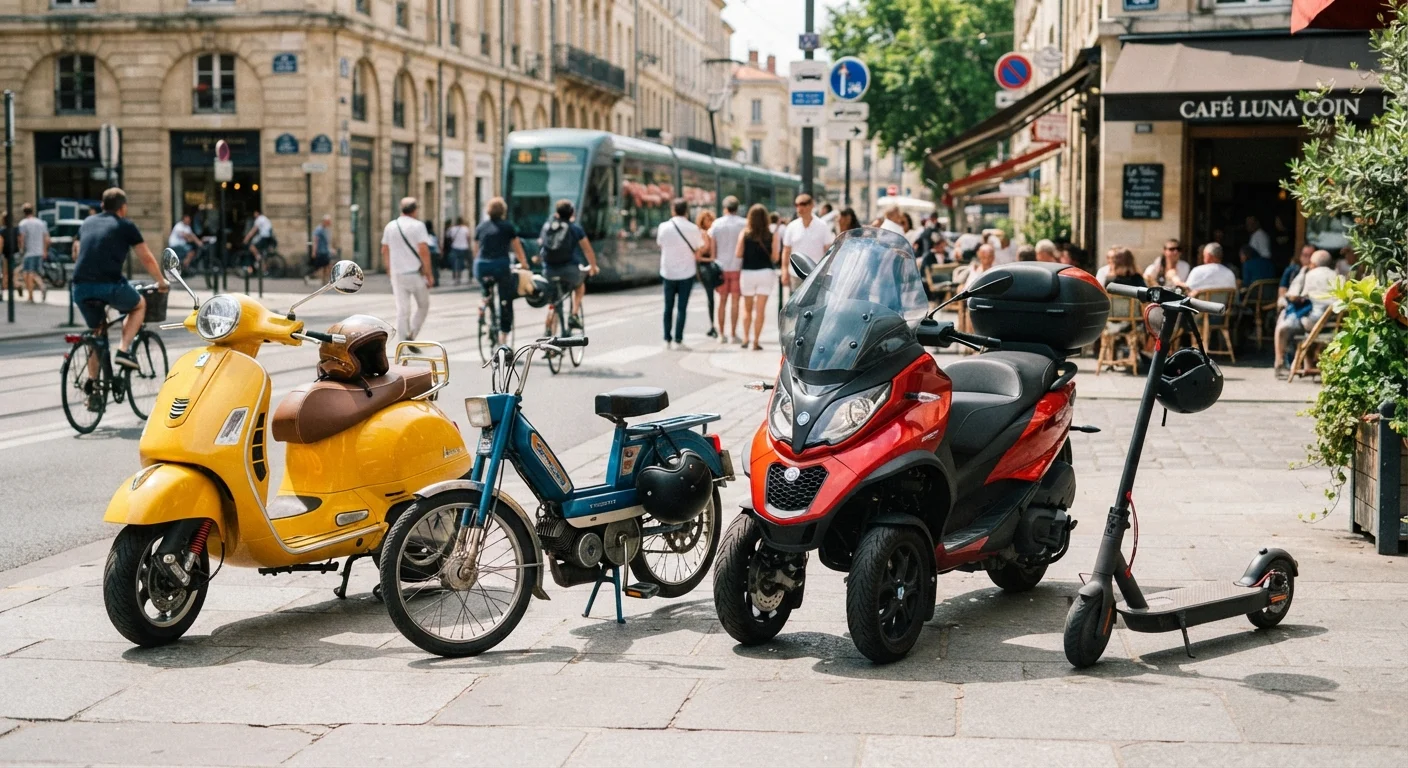
Mopeds are among the most regulated and narrowly defined small vehicles. Traditionally, a moped combined human-powered pedals with a small motor — typically 50cc or less — and was limited to speeds of 30 mph or below. Modern usage has blurred that definition, and many states now define mopeds purely by engine size and speed cap, regardless of whether pedals are present.
Scooters share the moped's step-through frame but generally lack pedals and come in a wider range of engine sizes — from 50cc neighborhood models to 400cc-plus machines capable of highway speeds. The step-through design and underseat storage make scooters particularly practical for urban commuting. Riders on larger scooters often describe handling characteristics that feel more accessible than traditional motorcycles, though the two-wheeled dynamics and associated risks remain.
Electric scooters add another layer of complexity. A low-speed electric scooter may be classified similarly to a bicycle in some states, while a higher-output model may cross the threshold into moped or motorcycle territory. The relevant classification typically hinges on maximum assisted speed rather than motor wattage alone.
Check Your State's Definition Before You Buy
The same scooter can be classified as a moped in one state and a motorcycle in another, based on subtle differences in state law. Before purchasing, contact your state's DMV with the vehicle's engine displacement and maximum speed to confirm exactly which license, registration, and insurance requirements apply to you.
Motorized Trikes and Three-Wheelers
Three-wheeled motorized vehicles come in two broad configurations. Delta trikes have one wheel in front and two in the rear — the layout used by many classic sidecar-style rigs and some modern touring trikes. Tadpole trikes reverse this arrangement, with two wheels in front and one at the rear, a design favored in performance-oriented and recumbent models.
A separate and growing category is the autocycle — an enclosed or semi-enclosed three-wheeler that features car-like controls (steering wheel, foot pedals) rather than motorcycle-style handlebars. Several states have enacted specific autocycle statutes that exempt these vehicles from motorcycle helmet laws and licensing requirements, though rules vary considerably.
Trikes are often chosen by riders who want stability at low speeds or who have physical limitations that make balancing a two-wheeler difficult. However, trikes handle differently from motorcycles in curves — they do not lean into turns — and require specific rider training. The motorcycle class breakdown provides useful context on how trikes compare to conventional motorcycle designs.
Autocycle Laws Are Still Evolving
As of the mid-2020s, fewer than half of U.S. states have enacted dedicated autocycle statutes. If you live in a state without one, a three-wheeled vehicle with car-like controls will still be classified under existing motorcycle law. Verify your state's current classification before assuming a standard driver's license is sufficient.
Licensing, Registration, and Road Rules
Licensing requirements for small motorized vehicles are set at the state level and vary more than most riders expect. As a general rule:
- Mopeds (50cc or under, 30 mph max): A standard driver's license is sufficient in most states. Some states require a separate moped permit or endorsement.
- Scooters over 50cc: A motorcycle endorsement or separate motorcycle license is typically required.
- Three-wheelers: Most states classify them as motorcycles, requiring a motorcycle endorsement. States with autocycle statutes may allow operation with a standard driver's license for qualifying vehicles.
Registration and insurance requirements follow similar logic — lower-powered vehicles often face fewer requirements, while anything that can reach highway speeds is usually subject to full registration, titling, and liability insurance mandates.
Helmet laws also differ: some states mandate helmets for all riders, others only for riders under a certain age, and a handful have no universal helmet requirement. Always consult your state's Department of Motor Vehicles for current requirements before purchasing or riding any of these vehicles.
Matching the Vehicle to Your Needs
Choosing among these vehicle types is ultimately a function of where you'll ride, how far, and what license you already hold or are willing to obtain.
- Urban short-haul commuting: A 50cc or electric scooter handles city blocks efficiently, typically requires minimal licensing, and is easy to park.
- Mixed urban and suburban riding: A 150cc–300cc scooter offers more speed range and is highway-adjacent in many states, though still more practical than a full motorcycle for stop-and-go traffic.
- Riders seeking stability: A delta trike or autocycle removes the balancing requirement entirely, making it accessible to a wider range of riders.
- Long-distance or touring: Larger-displacement three-wheelers can cover highway miles comfortably, though they require more storage space and often carry a higher acquisition and operating cost.
If you're still deciding whether a two- or three-wheeler fits your lifestyle versus a conventional car, the framework in choosing a vehicle type to match how you actually drive can help you think through that comparison systematically. For those considering electric powertrains, our electric vehicle primer explains the core technology across vehicle categories.