
The Core Difference: How the Vehicle Is Built
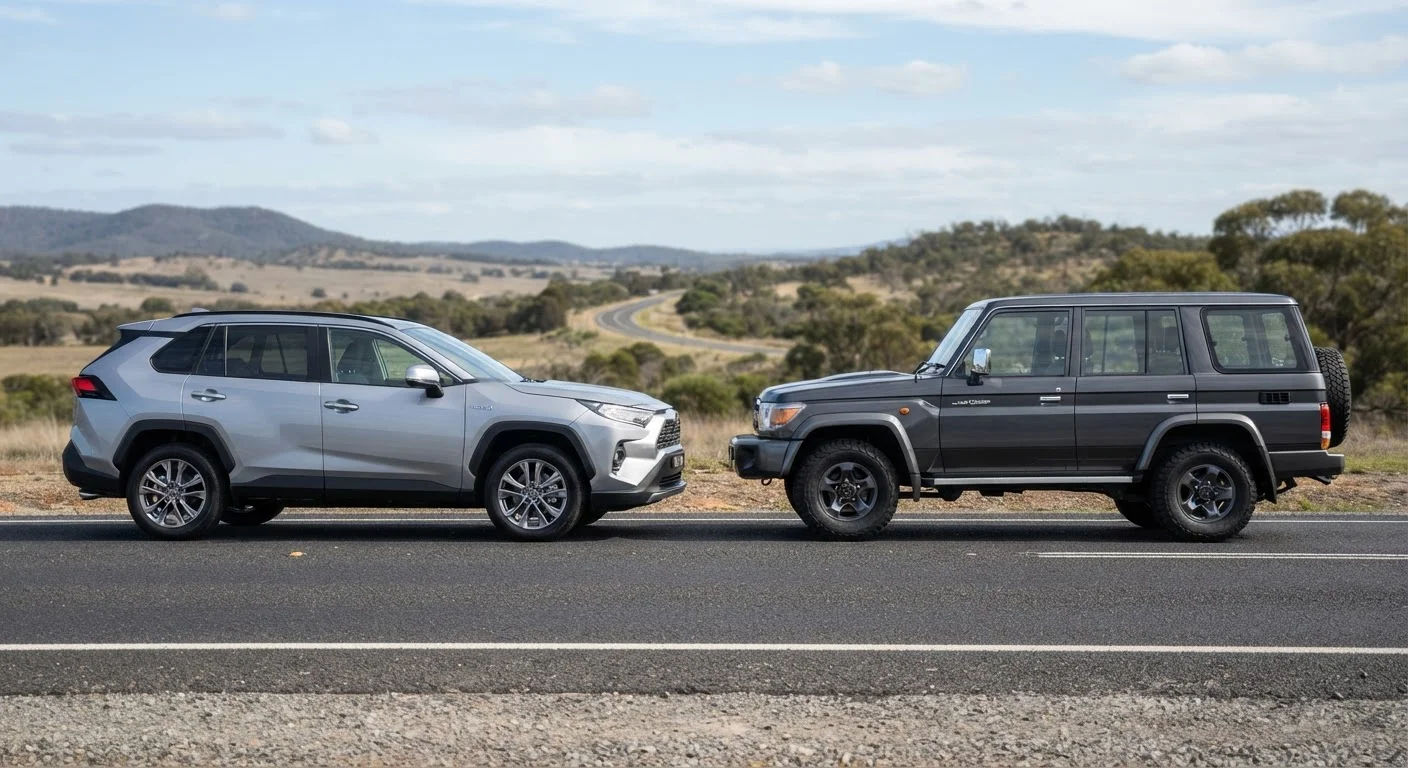
The clearest way to understand the crossover-versus-SUV distinction is to look beneath the exterior. A traditional SUV is built on a body-on-frame platform — the same basic architecture used by pickup trucks. A rigid steel ladder frame provides the structural foundation, and the passenger cabin is bolted on top. This setup is engineered for strength, load-bearing, and the stresses of towing and rough terrain.
A crossover, by contrast, is built on a unibody platform, where the frame and body are a single integrated structure — the same approach used in sedans and hatchbacks. This makes crossovers lighter and more rigid in a way that favors on-road handling and efficiency rather than raw hauling capability.
For a broader look at how these categories fit into the full spectrum of American vehicle types, see our guide to American vehicle classifications.
~80%
Share of U.S. SUV sales that are crossovers
Industry analysts broadly estimate that the large majority of light trucks sold as SUVs in the U.S. are unibody crossovers rather than body-on-frame vehicles.
7,000–8,500 lbs
Typical tow rating for full-size body-on-frame SUVs
Manufacturer-published tow ratings for full-size body-on-frame SUVs such as those based on truck platforms generally fall in this range.
10–15%
Approximate fuel economy advantage of crossovers over comparable SUVs
Unibody construction and lower curb weight contribute to crossovers generally achieving better fuel efficiency than similarly sized body-on-frame SUVs in EPA testing.
Ride, Handling, and Everyday Comfort
Because crossovers share their underpinnings with passenger cars, they typically deliver a smoother, more refined ride on paved roads. Steering tends to be more responsive, road noise is often better managed, and the driving experience feels more intuitive to drivers accustomed to sedans. The lower center of gravity also reduces body roll in corners.
Traditional SUVs, with their stiffer body-on-frame construction, can feel more truck-like — particularly noticeable over bumps or in tight turns. For drivers who spend most of their time in cities or on highways, this difference in daily comfort is meaningful.
Test Drive Both Before Deciding
If you're undecided between a crossover and a traditional SUV, drive both back-to-back on a route that reflects your typical use — city streets, highway merges, and if relevant, a gravel or unpaved stretch. The difference in ride feel and steering response is often more apparent in practice than it appears on a spec sheet.
Capability: Towing, Off-Road, and Payload
Where traditional SUVs maintain a clear advantage is in heavy-duty capability. The ladder-frame structure allows for substantially higher tow ratings — full-size body-on-frame SUVs can typically tow 7,000 to 8,500 pounds or more, while most crossovers are rated for 1,500 to 5,000 pounds depending on size and configuration.
Off-road durability is also where the traditional SUV earns its reputation. Higher ground clearance, available locking differentials, and dedicated off-road suspension tuning make body-on-frame vehicles the choice for serious trail use. Crossovers with all-wheel drive can handle snow, light gravel, and mild terrain, but they are not designed to withstand the repeated stresses of rock crawling or deep mud.
If you're weighing the merits of larger vehicle formats, our article on three-row SUVs explores the practical trade-offs involved in going bigger.
Why the Labels Get Confusing — and What to Do About It
Today, the word "SUV" is used by manufacturers and media alike to describe both crossovers and traditional SUVs. The vast majority of vehicles currently sold under the SUV banner are technically crossovers. This overlap is largely a marketing phenomenon — consumers associate SUVs with versatility, and the label has expanded to accommodate nearly any raised, utility-style vehicle.
For practical decision-making, focus less on the label and more on your actual needs. If you tow heavy loads, need serious off-road ability, or require high payload capacity, a body-on-frame SUV or truck deserves serious consideration. If you prioritize fuel efficiency, daily driving comfort, and a car-like experience with added cargo room, a crossover is likely the better match.
Our framework for matching a vehicle type to your driving habits can help you work through that decision systematically. And if you're considering how powertrain technology factors in, see our breakdown of hybrid and plug-in hybrid systems, which are now widely available in both crossovers and SUVs.
“The line between crossovers and SUVs has become almost entirely a marketing distinction. What matters for consumers is understanding the underlying platform — because that's what determines how the vehicle actually behaves.”
— Automotive Engineering Perspective, General industry framing on vehicle platform classification