
Why These Three Services Get Lumped Together
All three services involve your tires and wheels, which is where the similarity ends. Shops sometimes bundle them into maintenance packages, and the overlapping terminology — rotation, balance, alignment — makes it easy to assume they're variations of the same procedure. They're not. Each one uses different equipment, addresses a different problem, and follows a different service interval.
Confusing them has real consequences. A driver who skips alignment because they "just had the tires rotated" is leaving a separate, unrelated problem unaddressed. Understanding what each service actually corrects makes it easier to recognize the symptoms and respond appropriately.
Tire Rotation: Managing Uneven Wear Before It Starts
Tires wear unevenly because they don't all carry the same load or perform the same job. On a front-wheel-drive vehicle, the front tires handle both steering and power delivery, wearing faster than the rears. On rear-wheel-drive cars, the reverse is true. Even all-wheel-drive systems don't perfectly equalize the stress across all four tires.
Rotation solves this by periodically moving tires to different positions — front to rear, side to side, or in an X-pattern — so each tire experiences different wear conditions over its life. The goal is to have all four tires wear at roughly the same rate, maximizing the set's overall lifespan.
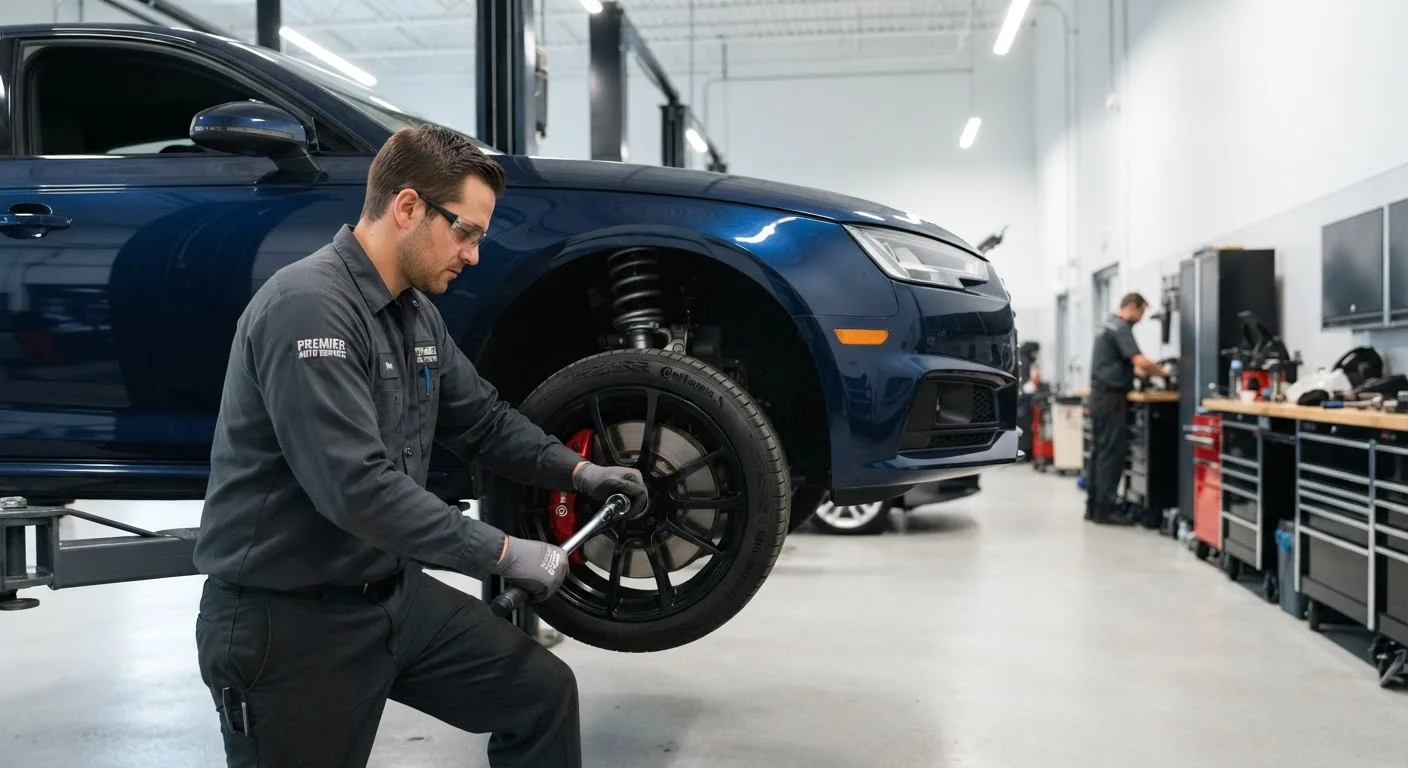
Most manufacturers recommend rotating tires every 5,000 to 7,500 miles, though your owner's manual is the authoritative source. Many drivers time it with oil changes for convenience. Rotation requires no special alignment or balancing equipment — it's a lift, a torque wrench, and a predetermined pattern.
Pair Rotation With a Visual Inspection
Each rotation appointment is a good opportunity to have a technician inspect tread depth, sidewall condition, and tire pressure across all four tires. Catching an irregular wear pattern early can reveal a separate balancing or alignment issue before it becomes more expensive to correct.
Wheel Balancing: Correcting Hidden Weight Imbalances
Even a new tire mounted on a new rim isn't perfectly uniform. Tiny variations in rubber distribution and rim weight mean the assembly won't spin in a perfectly smooth arc. When a wheel is out of balance, it creates a rhythmic vibration — typically felt in the steering wheel, seat, or floorboard — that worsens at highway speeds.
A technician uses a balancing machine to spin the wheel and measure where the weight is unevenly distributed. Small metal weights are then clipped or taped to the rim at precise locations to counteract the imbalance. The entire process usually takes under 30 minutes per wheel.
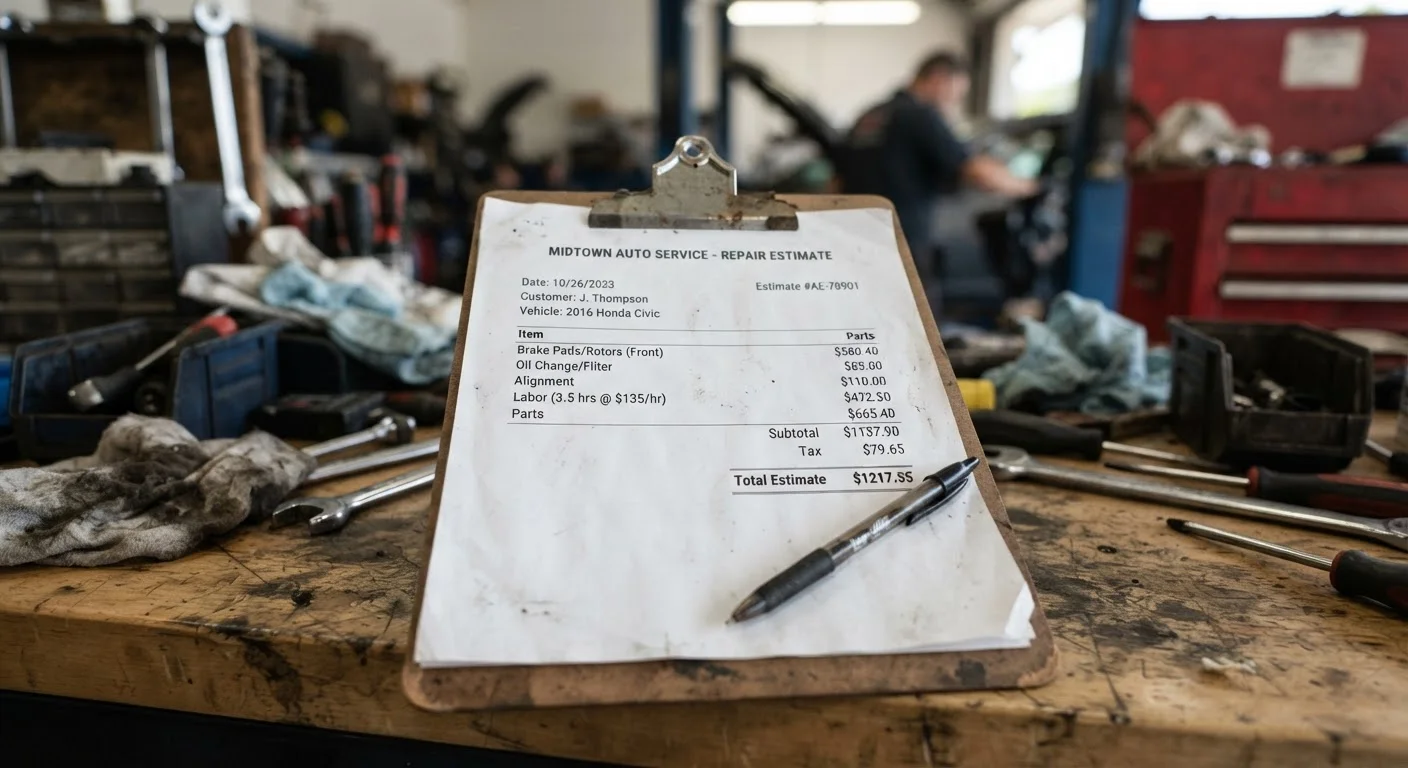
Balancing is typically recommended when you notice vibration, after mounting new tires, or about every 12,000 to 15,000 miles as a precaution. It has nothing to do with the angle of your wheels — that's alignment's job. See our guide to reading a repair estimate if you want to understand how shops price this service.
| Tire Rotation | Wheel Balancing | Wheel Alignment | |
|---|---|---|---|
| What it fixes | Uneven tread wear across tires | Vibration from weight imbalance | Incorrect wheel angles causing pull or wear |
| Common symptom | Faster wear on drive axle tires | Vibration at highway speeds | Vehicle pulls left or right |
| Typical interval | Every 5,000–7,500 miles | Every 12,000–15,000 miles or new tires | Annually or after a significant impact |
| Equipment used | Lift and torque wrench | Spin-balancing machine with weights | Four-wheel alignment rack |
| DIY feasibility | Possible with proper tools | Requires shop equipment | Requires shop equipment |
| Approximate cost range | $20–$50 per service | $15–$25 per wheel | $75–$150 for four-wheel alignment |
Wheel Alignment: Correcting the Angles Your Tires Make With the Road
Alignment is a geometry service. It measures and adjusts the angles at which your tires contact the road — specifically camber (the tilt of the tire when viewed from the front), toe (whether tires point inward or outward when viewed from above), and caster (the steering axis angle). When these angles are off, tires scrub against the pavement incorrectly, wearing in distinctive patterns and causing the vehicle to pull to one side.
Alignment goes out of spec gradually through normal driving, and suddenly after impacts — a hard pothole, a curbed wheel, or a minor collision. A four-wheel alignment check on a modern alignment rack reads all angles simultaneously and produces a printout showing which measurements are within spec and which need adjustment.
Unlike rotation and balancing, alignment adjustments involve physically moving suspension and steering components — tie rods, camber bolts, or control arm positions — depending on what the vehicle's suspension design allows. This is a task that requires proper equipment and a qualified technician. If your vehicle is pulling or you notice one-sided tread wear, ask your shop specific questions before approving the work.
Don't Ignore Pulling or Vibration
A vehicle that drifts to one side or produces a persistent steering-wheel vibration isn't just uncomfortable — it signals that something mechanical needs attention. Ignoring these symptoms can accelerate tire wear and, in the case of alignment issues, place additional stress on suspension and steering components over time. Have the vehicle inspected promptly rather than waiting for a scheduled maintenance visit.
Choosing Where to Have These Services Done
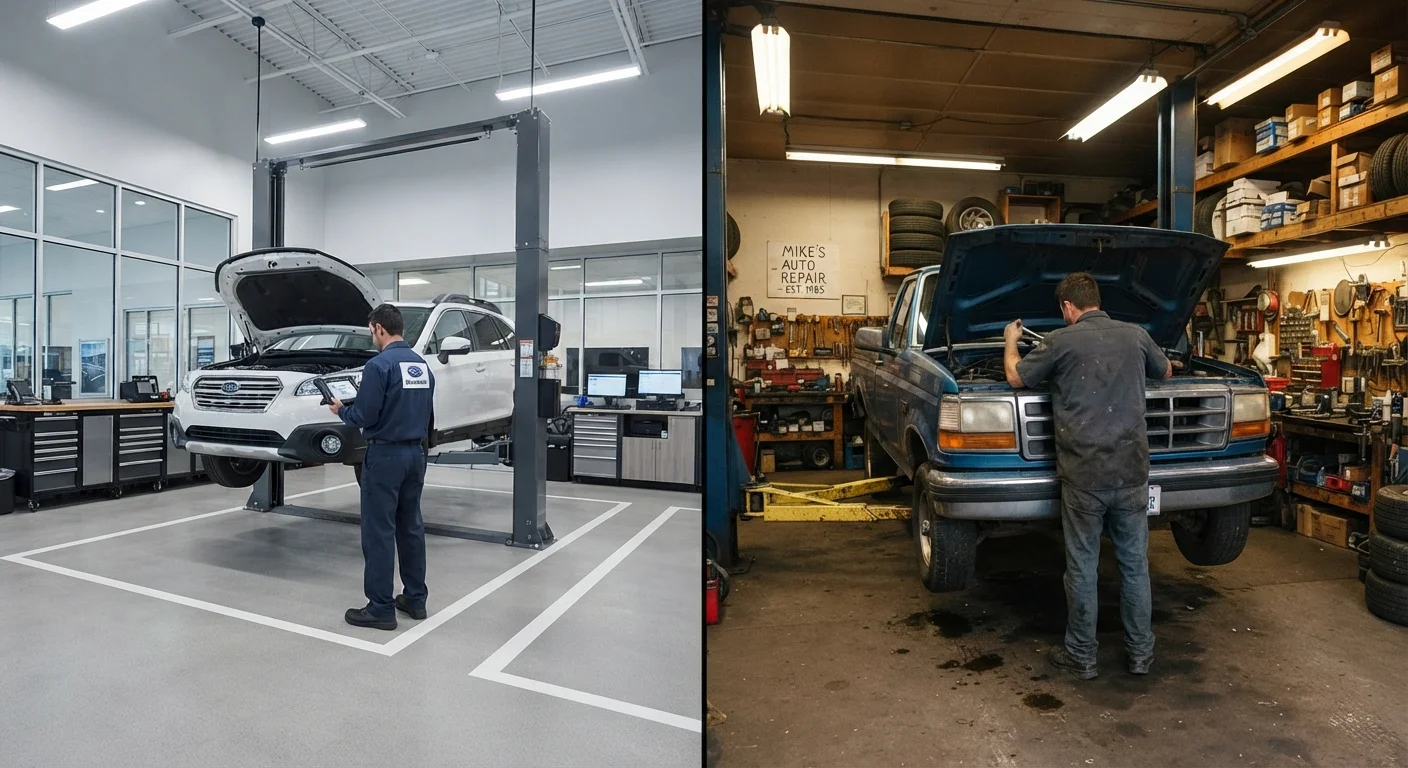
All three services are widely available at tire shops, dealership service centers, and independent mechanics. The equipment used — balancing machines and alignment racks — is standardized, so the service itself doesn't differ dramatically by location. What does vary is price, wait time, and whether the technician is likely to flag related issues accurately.
Our comparison of dealership service centers and independent mechanics covers the broader trade-offs in detail. For tire-specific work, the key is confirming that the shop has a four-wheel (not two-wheel) alignment rack and that the technician provides a before-and-after printout — this is standard practice and gives you documentation that the work was actually performed and corrected.
Keeping up with all three services is part of broader vehicle maintenance. If you're also tracking fluid services, see our guide on transmission fluid, coolant, and other overlooked fluids for a complete picture of routine upkeep.