
Why the Nutrition Facts Label Exists — and What It Can Tell You
The Nutrition Facts label is a federally standardized panel required on most packaged foods sold in the United States. The U.S. Food and Drug Administration (FDA) mandates its format to give consumers a consistent, comparable snapshot of a food's nutritional makeup. When you learn to read it systematically, you stop being influenced by front-of-package marketing claims and start making decisions based on actual content.
The label covers calories, macronutrients (fat, carbohydrates, protein), selected micronutrients, and ingredient composition. Each section serves a distinct purpose, and reading them in the right order prevents common misinterpretations. For a deeper look at where nutrients appear in your diet beyond packaged foods, the quick-reference guide to vitamins and minerals is a useful complement to this guide.
What you will need
Step-by-Step: Decoding Every Section of the Label
Follow these steps in order. Each builds on the one before, so skipping ahead — for example, looking at calories before checking serving size — often leads to inaccurate conclusions.
Start with the serving size
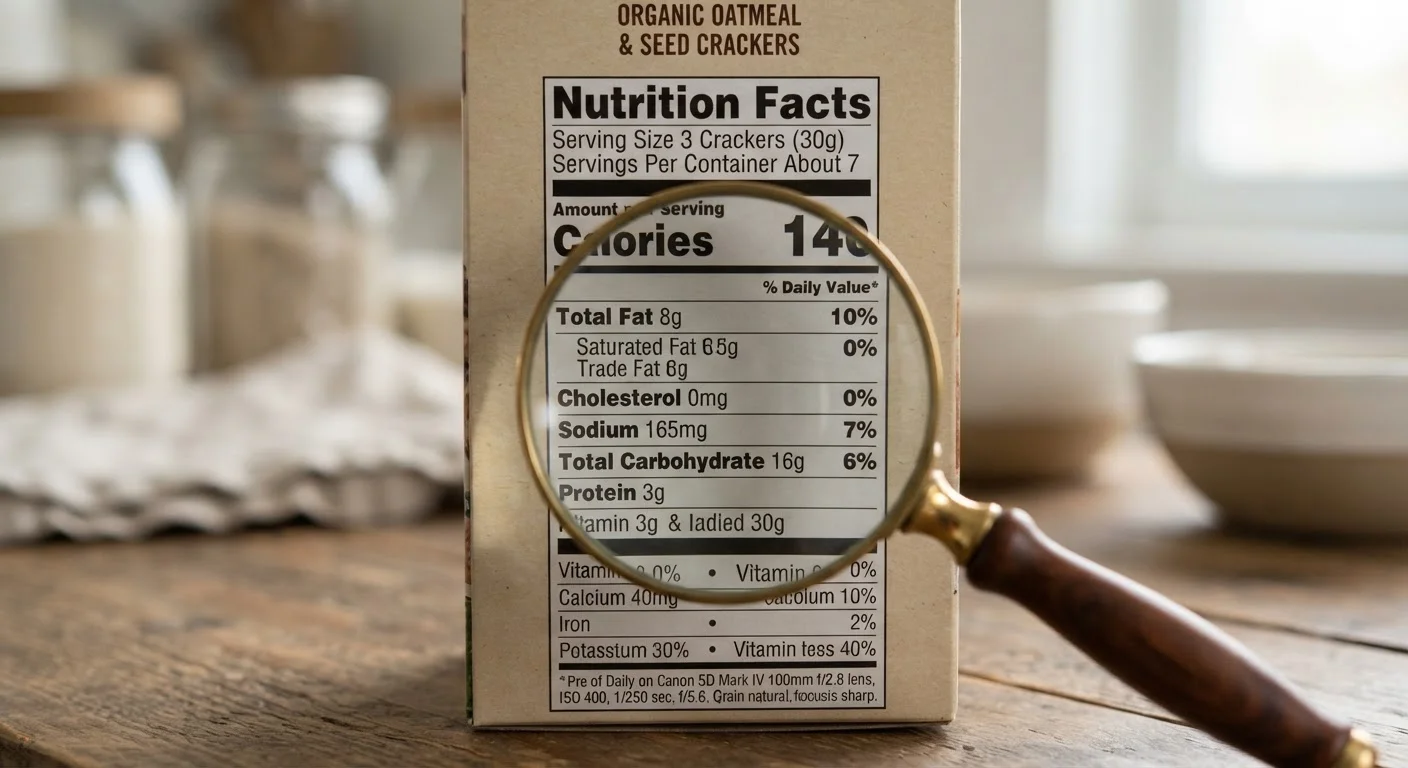
The very first line under "Nutrition Facts" states the serving size and the number of servings per container. Every number on the label — calories, fat grams, % Daily Values — applies to one serving, not the entire package. If a bag of chips lists 7 chips as one serving but you eat 21, multiply every figure by three. This single step changes the meaning of the entire label.
Read the calorie count in context
Calories measure the total energy a serving provides. The FDA's general guidance uses 2,000 calories per day as a reference point, though individual needs vary considerably based on age, sex, activity level, and health status. Rather than treating the calorie number as a hard verdict, use it as one data point alongside the nutrient profile.
Use % Daily Value as your compass
The % Daily Value (%DV) column shows how much a nutrient in one serving contributes to a 2,000-calorie daily diet. The FDA's rule of thumb: 5% DV or less is considered low; 20% DV or more is considered high. Use this shortcut to quickly flag foods that are high in nutrients you want to limit (saturated fat, sodium, added sugars) or rich in nutrients you may want more of (fiber, vitamin D, calcium, iron, potassium).
Examine nutrients to limit
Four nutrients are highlighted on the label because most Americans consume them in excess: saturated fat, trans fat, sodium, and added sugars. Diets consistently high in these are associated with increased risk of cardiovascular disease and other chronic conditions, according to public health research. Aim for a low %DV in these rows when evaluating packaged foods.
Check nutrients to encourage
The lower section of the label highlights nutrients many Americans under-consume: dietary fiber, vitamin D, calcium, iron, and potassium. A higher %DV in these rows generally indicates a food contributing positively to nutritional gaps in the typical American diet. Fiber, in particular, supports digestive health and satiety.
Read the ingredient list from top to bottom
Ingredients are listed in descending order by weight — the first ingredient is present in the greatest amount. A food whose first three ingredients are whole wheat flour, oats, and water has a fundamentally different composition than one whose first ingredients are enriched flour, sugar, and palm oil. Scan for recognizable, whole ingredients near the top, and be aware that a long list of unfamiliar additives doesn't automatically mean a food is unhealthy — and vice versa.
Comparing Products Side by Side
When choosing between two similar packaged foods, standardize your comparison by checking that the serving sizes are equivalent before comparing any numbers. Manufacturers define serving sizes differently, and a direct calorie or sodium comparison is only valid when you're looking at the same quantity of food.
Once you're comfortable reading individual labels, you can apply this framework while shopping. The grocery shopping with nutrition in mind checklist shows how to use label-reading skills throughout a full store visit.
Common Label Traps and How to Avoid Them
Even attentive readers fall into predictable patterns that distort what a label actually communicates.
- Front-of-package claims vs. label reality: Words like "natural," "light," or "multigrain" have limited or loosely defined regulatory meaning. Always verify the claim against the Nutrition Facts panel and ingredient list before accepting it at face value.
- Added sugars hiding in ingredient lists: Sugar appears under more than 60 names — from "evaporated cane juice" to "dextrose" to "agave nectar." The hidden sources of added sugar article details the most common aliases and where they appear in everyday products.
- Whole grain marketing: A product labeled "made with whole grains" may contain only a small proportion. Check that a whole grain appears as the first ingredient, and see whole grains vs. refined grains for more context on what that distinction means nutritionally.
- Low-fat but high-sugar: Reduced-fat products often compensate with added sugars to maintain palatability. Reading both the fat row and the added sugars row together prevents this blind spot.
Labels Have Limits — They Don't Tell the Full Story
Nutrition Facts labels cover regulated nutrients but cannot capture everything relevant to a food's healthfulness — phytochemicals, food processing level, and overall dietary pattern all matter and aren't reflected on the panel. Use labels as a useful tool for comparison and awareness, not as the sole determinant of whether a food belongs in your diet.
Well-intentioned label-reading habits can sometimes create new problems. The "When Healthy Eating Habits Quietly Go Wrong" article explores how overfocus on specific numbers can inadvertently undermine nutritional balance.
This article is for general informational and educational purposes only and is not a substitute for personalized dietary or medical advice. Consult a registered dietitian or qualified healthcare professional for guidance tailored to your individual health needs.