
What Hair Porosity Actually Means
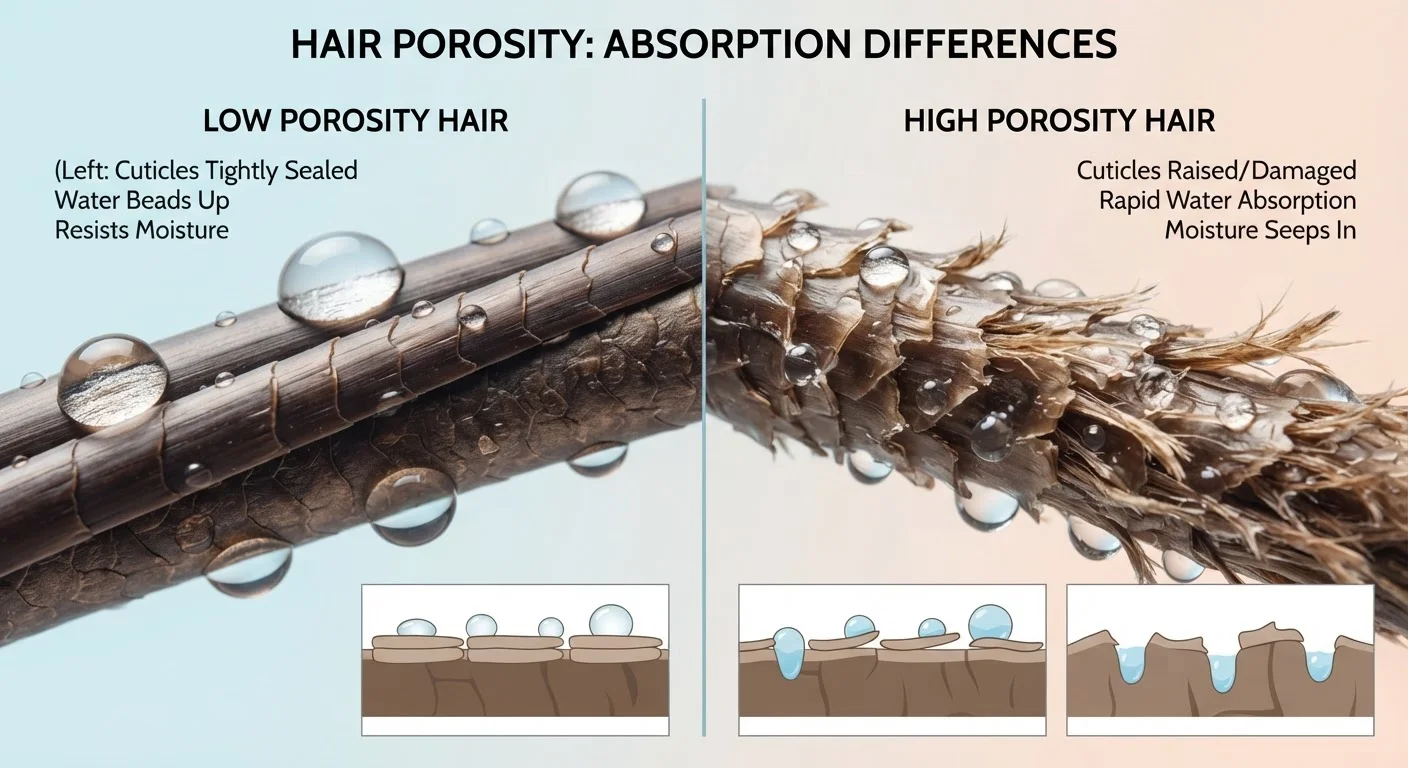
Every hair strand is wrapped in a cuticle — a layer of overlapping, scale-like cells that act as the strand's first line of defense. How tightly or loosely those scales lie determines your hair's porosity. When the cuticle is compact and flat, moisture (and products) have a hard time getting in. When it is raised or irregular, the same moisture enters freely but escapes just as easily.
Porosity is typically grouped into three categories:
- Low porosity: Cuticle scales lie flat and tightly packed. Water beads on the surface and takes time to absorb. Products tend to sit on top rather than penetrate.
- Medium (normal) porosity: Cuticle scales are slightly lifted, allowing a balanced exchange of moisture. Hair responds predictably to most products and holds styles relatively well.
- High porosity: Cuticle scales are significantly raised, gaps may exist due to damage, and hair absorbs moisture quickly — but loses it nearly as fast. Dryness, frizz, and breakage are common concerns.
Understanding which category fits your hair is the first step toward building a routine that works. For context on how porosity connects to other characteristics of your hair, see hair type, texture, and density.
How to Test Your Porosity at Home
No lab equipment is needed to get a reasonable read on your hair's porosity. Two simple observations can point you in the right direction:
The Float Test
Take a clean, shed strand — ideally after shampooing to remove buildup — and drop it into a glass of room-temperature water. Wait two to four minutes without disturbing the glass. A strand that floats near the top suggests low porosity; one that sinks to the bottom points to high porosity; one that hovers in the middle suggests medium porosity. Note that product residue can affect results, so use a freshly cleaned strand.
The Spray Test
Mist a small section of dry hair with water and watch what happens. If water droplets sit on the surface and bead up, the cuticle is fairly closed (low porosity). If the water disappears almost immediately, the cuticle is open (high porosity).
These tests are practical guides, not clinical diagnoses. Many people have mixed porosity — different porosity levels across different sections or lengths of hair — so testing a few areas can give a more complete picture.
Mixed Porosity Is Common
Many people have different porosity levels in different areas of their hair — roots that are lower porosity and ends that are higher, for example. This is especially common in longer hair with years of accumulated exposure. If your results from the float test seem inconsistent, try testing strands from different sections of your head before drawing conclusions.
Why Porosity Matters for Products and Routines
Porosity is arguably the most underutilized piece of information in hair care. It explains why a product that leaves one person's hair silky makes another person's hair feel heavy or dry.
3 Layers
Structural layers in each hair strand
Each strand is composed of the cuticle (outer), cortex (middle), and medulla (inner), with porosity determined by the cuticle's condition.
~50–100
Hair strands lost naturally per day
According to the American Academy of Dermatology, losing up to 100 strands daily is considered within the normal range for most adults.
Low Porosity Hair
The challenge here is getting moisture in. Heavy butters and thick creams are more likely to cause buildup than to hydrate. Lightweight, liquid-based products and applying them while hair is already wet are more effective strategies. Adding gentle warmth during deep conditioning — such as a steamer or a warm towel wrap — can temporarily lift the cuticle. Check the differences between conditioners and deep conditioning treatments to match the right product to your routine.
High Porosity Hair
The challenge here is keeping moisture in. Hydrating products need to be sealed in with something that forms a barrier — such as an oil or cream applied on top. Protein treatments may help temporarily reinforce the cuticle, but they should be balanced with moisture to avoid stiffness. Frequent use of clarifying shampoos can strip what little moisture barrier exists; understanding when to use them versus a moisturizing formula matters. See clarifying vs. moisturizing shampoos for guidance on that choice.
For both porosity types, reading ingredient labels is worthwhile. Knowing what humectants, emollients, and occlusives do — and which your hair responds to — makes product selection much less guesswork. A plain-language reference is available in the hair ingredient glossary.
Layer Products in the Right Order
A practical approach for most porosity types is to apply products from lightest to heaviest: start with a water-based leave-in or mist, follow with a cream or lotion, then seal with a small amount of oil if needed. This layering method — sometimes called the LOC or LCO method — helps both draw in and lock in moisture regardless of your porosity level.
What Changes Porosity Over Time
Genetics give you a baseline porosity level, but it is not fixed. Several common factors raise porosity by lifting or eroding the cuticle:
- Chemical treatments: Bleaching, coloring, relaxing, and perming all physically alter the cuticle structure, typically pushing porosity higher.
- Heat styling: Repeated use of high heat without protective measures gradually roughens the cuticle surface.
- Mechanical damage: Rough towel drying, aggressive brushing while wet, and tight hairstyles that cause traction all contribute to cuticle wear.
- Environmental exposure: Sun, hard water minerals, and chlorine from pools can degrade the cuticle over time.
Hair that has already grown out cannot be fundamentally restructured — only managed. New growth, however, will reflect your current habits. Reducing unnecessary damage protects the porosity of incoming hair. Habits like regular trims, minimizing heat exposure, and protective styling are discussed further in evidence-based hair care habits.
This article is for general informational purposes. Individual hair care needs vary; consult a licensed cosmetologist or trichologist for personalized guidance.